
What happens when your transportation system knows something… but your ERP doesn’t?
That’s the challenge many freight forwarders are facing in 2026.
CargoWise continues to be one of the most widely used logistics platforms for managing freight operations, documentation, customs, and financial workflows. But as transportation networks become more complex, many logistics businesses are realizing that one platform alone is no longer enough to manage everything efficiently.
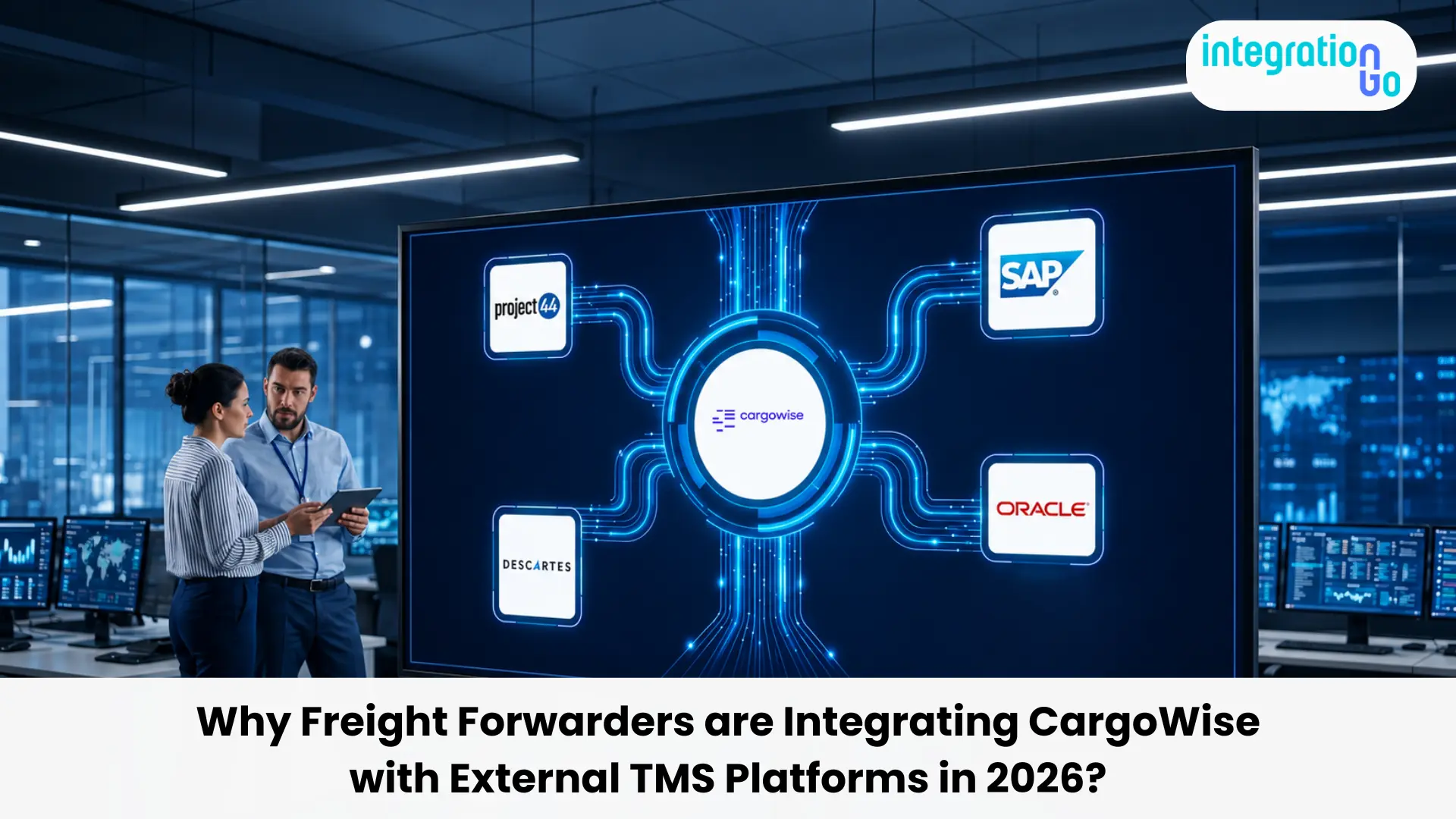
This is why freight forwarders are integrating External TMS Platforms with CargoWise to improve visibility, simplify workflows, and create faster decision-making across operations.
🌐 Why Freight Operations Need More Connected Systems?
Modern freight forwarding is no longer limited to shipment execution alone.
Businesses today manage multi-modal transportation, real-time tracking, customer visibility, carrier coordination, route optimization, and financial operations all at the same time.
While CargoWise handles core logistics workflows effectively, many companies now rely on specialized TMS platforms to strengthen transportation planning and visibility.
The goal is not to replace CargoWise. The goal is to extend its capabilities through integration.
🔄 What is a Transportation Management System (TMS)?
A Transportation Management System (TMS) helps businesses plan, execute, optimize, and monitor freight movement across the supply chain.
These platforms improve transportation visibility and help logistics teams manage carrier performance, route planning, shipment tracking, and delivery coordination more efficiently.
Some widely used TMS platforms in the logistics industry include:
- project44
- SAP Transportation Management
- Oracle Transportation Management (OTM)
- CargoWise Transport Management
- Magaya TMS
Each platform offers different strengths, but the common goal is improving transportation control and visibility.
⚠️ The Problem with Disconnected Logistics Systems
Many freight forwarders still operate with disconnected systems across transportation, operations, and finance.
Shipment execution may happen in CargoWise.
Tracking updates may come from another TMS platform.
Financial workflows may sit in separate systems.
This creates operational gaps.
Teams often spend time:
- Switching between systems for updates
- Re-entering shipment information manually
- Reconciling data across platforms
- Delaying decisions due to incomplete visibility
As shipment volumes grow, these disconnects become harder to manage and begin to slow operations.
🔗 Why CargoWise Integration is Becoming Essential?
This is where integration changes everything. By integrating External TMS Platforms with CargoWise, freight forwarders create a connected environment where operational, transportation, and financial data flow together in real time.
Instead of isolated systems, businesses gain a synchronized workflow.
This integration allows:
- Real-time transportation updates inside CargoWise
- Faster communication between carriers and operations teams
- Improved shipment visibility across air, ocean, and road freight
- Better coordination between operations and finance
- Reduced manual updates and duplicate data entry
The result is not just better system performance, it’s smoother logistics execution.
📦 How Integration Improves Shipment Visibility?
One of the biggest reasons freight forwarders are integrating external TMS platforms is visibility.
Customers now expect real-time shipment updates and accurate delivery information. Manual tracking processes can no longer keep up with these expectations.
When CargoWise is integrated with platforms like project44 or CargoWise TMS, businesses gain access to:
- Live shipment tracking
- Automated milestone updates
- Real-time ETA visibility
- Carrier performance insights
- Faster issue identification and response
This helps freight forwarders provide a more transparent and reliable customer experience.
⚡ Faster Operations with Less Manual Work
Disconnected systems create repetitive operational tasks. Teams often need to transfer information between transportation systems and ERP platforms manually. This slows down workflows and increases the risk of errors.
Integration removes much of this manual effort.
Shipment data can flow automatically between integrating External TMS Platforms with CargoWise, allowing operations teams to work with accurate, synchronized information.
This improves:
- Shipment processing speed
- Operational accuracy
- Workflow consistency
- Team productivity
Instead of managing disconnected updates, teams can focus on managing freight movement.
📊 Better Decision-Making Through Real-Time Data
Modern logistics decisions depend on real-time information. Without integration, businesses often work with delayed or incomplete data. This affects planning, customer communication, and operational efficiency.
Integrated systems provide a unified view of operations by connecting transportation data directly into CargoWise workflows.
This helps freight forwarders:
- Respond faster to disruptions
- Improve transportation planning
- Optimize carrier usage
- Track profitability more accurately
Real-time visibility creates faster and more confident decision-making.
🚀 Why 2026 is Accelerating Integration?
Several factors are driving this shift toward connected logistics platforms in 2026:
- Increasing shipment volumes
- Rising customer expectations for visibility
- Greater reliance on real-time tracking
- Growing complexity across transportation networks
- Pressure to reduce operational inefficiencies
Freight forwarders are no longer asking whether integration is important. They are asking how quickly they can implement it.
🔮 The Future of Connected Freight Operations
The future of freight forwarding is not about using more systems, it’s about connecting the right systems together.
CargoWise remains a powerful operational platform, but integrating it with specialized TMS platforms creates a more agile and responsive logistics environment.
Businesses that build connected workflows will be able to scale faster, improve visibility, and respond more effectively to operational challenges. In 2026, integration is becoming the foundation of smarter freight operations.
🚀 Final Thoughts
Integrating External TMS Platforms with CargoWise is helping freight forwarders create more connected, visible, and efficient logistics operations by improving real-time tracking, reducing manual workflows, and aligning transportation data across systems.
This is the right time to explore how End-to-End Logistics Integration can unify your platforms, simplify operations, and help your business move freight with greater speed, accuracy, and control.