
How long does it take for an invoice to move from shipment completion to payment processing inside your business?
For many logistics businesses, invoicing is still slower than the shipment itself.
Invoices are manually created, checked multiple times, uploaded into ERP systems, and then submitted separately to government tax portals. Finance teams spend hours validating shipment references, tax values, and billing details before an invoice is finally approved.
And here’s the real issue, even a small invoicing delay can affect cash flow, customer payments, and compliance reporting.
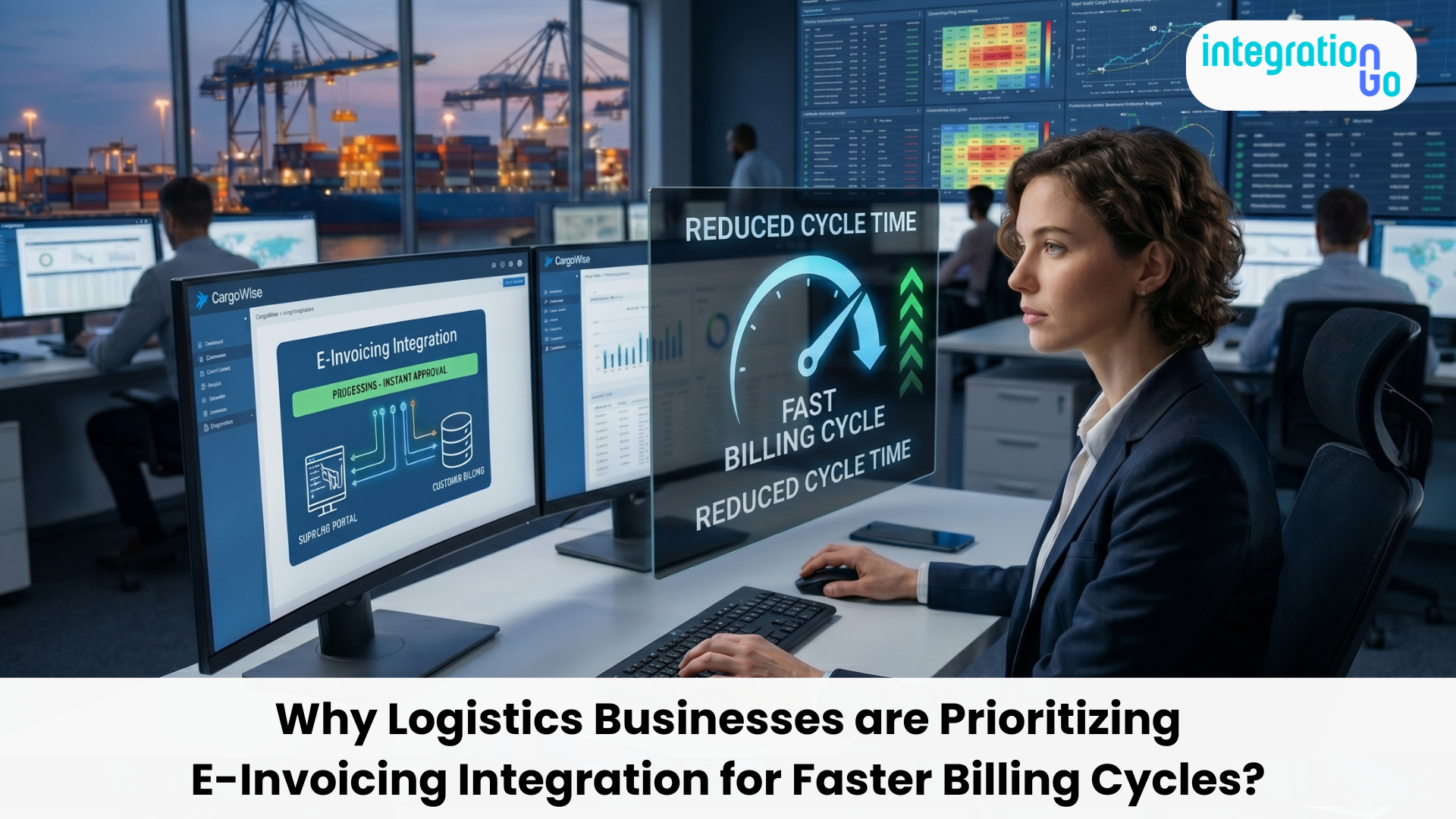
That’s exactly why logistics businesses in 2026 are rapidly prioritizing E-Invoicing Integration to create faster billing cycles, reduce manual processing work, and improve financial accuracy across logistics operations.
📄 Why E-Invoicing is Becoming Essential in Logistics?
E-invoicing is no longer just a finance process. It has become a core part of modern logistics operations.
Governments across multiple countries are introducing mandatory electronic invoicing requirements and stricter digital tax reporting systems. Logistics businesses now need to generate, validate, and submit invoices electronically while maintaining accurate operational and financial records.
For freight forwarders and logistics providers, this creates significant operational pressure because every invoice must:
- Match shipment and operational records
- Meet local tax regulations
- Be submitted in approved digital formats
- Maintain audit-ready compliance records
- Move quickly through billing workflows
Manual invoicing processes struggle to keep up with these requirements efficiently.
🌐 Connecting ERP Systems with Government E-Invoicing Platforms
Modern logistics operations rely on multiple systems for transportation, finance, and operational workflows.
This is why businesses are integrating ERP and logistics platforms directly with government-approved e-invoicing systems.
Commonly connected platforms include:
- CargoWise
- SAP
- Infor
- Oracle
- Magaya
- project44
With integration, invoice data flows automatically between operational systems and tax portals without repeated manual handling.
This creates:
- Faster invoice generation
- Better compliance visibility
- Reduced data duplication
- Improved billing consistency across systems
Instead of disconnected invoicing workflows, businesses operate through a more connected billing environment.
⚠️ Why Manual E-Invoicing Workflows Create Delays?
Manual invoice processing creates much more than administrative work.
Finance teams often spend large portions of the day:
- Re-entering invoice data into multiple systems
- Verifying shipment references manually
- Correcting invoice formatting errors
- Uploading invoices separately into compliance portals
- Following up on rejected or delayed submissions
Industry reports show that businesses using manual invoicing workflows can spend up to 60% more processing time per invoice compared to automated workflows.
The result is:
- Slower billing cycles
- Delayed customer payments
- Increased invoice rejection rates
- Higher compliance risks
- Reduced financial visibility
Even minor tax or formatting errors can delay invoice approval and payment processing.
🔄 How E-Invoicing Integration Speeds Up Billing Operations?
E-invoicing integration simplifies the entire invoice lifecycle. Instead of manually preparing and uploading invoices, integration automatically transfers invoice data between ERP systems and government portals.
This creates a faster and more reliable workflow.
Integrated invoicing systems can:
- Generate invoices automatically from shipment data
- Validate invoice fields before submission
- Synchronize tax and financial information in real time
- Submit invoices directly into government platforms
- Track invoice status automatically
Businesses implementing e-invoicing integration are significantly reducing invoice turnaround times because the process no longer depends on repeated manual handling.
📊 Why Logistics Businesses are Seeing Faster Billing Cycles?
One of the biggest operational benefits of e-invoicing integration is speed.
Research across digital finance operations shows that automated invoicing workflows can reduce invoice processing time by nearly 70% while improving billing accuracy significantly.
This helps logistics businesses:
- Accelerate invoice approvals
- Improve customer payment timelines
- Reduce manual reconciliation work
- Improve cash flow visibility
- Minimize delays in revenue recognition
For freight forwarders handling large shipment volumes, even reducing invoice processing by a few hours per day creates major operational improvements over time.
📑 Improving Tax Accuracy and Compliance Visibility
E-invoicing is directly connected to government tax compliance.
Incorrect invoice values, missing shipment references, or invalid tax information can lead to rejected submissions or compliance penalties.
E-invoicing integration improves this process by validating invoice information before submission.
This helps businesses:
- Reduce invoice submission errors
- Improve tax reporting accuracy
- Maintain digital audit trails
- Strengthen compliance reporting consistency
Instead of fixing compliance issues after submission, businesses can identify problems earlier within the workflow.
🔗 Creating a Real-Time Connection Between Logistics and Finance
In logistics, invoicing depends heavily on operational data.
Shipment references, transport charges, operational costs, and taxes all originate from logistics workflows. If operational systems and finance systems are disconnected, billing delays become common.
E-invoicing integration creates a synchronized environment where logistics operations and finance workflows stay connected in real time.
This improves:
- Coordination between finance and operations teams
- Faster invoice approvals
- Better shipment cost visibility
- Reduced reconciliation delays
- More accurate financial reporting
Instead of manually updating multiple systems, businesses work with connected workflows where information moves automatically.
🚛 Why Freight Forwarders are Accelerating Digital Billing in 2026?
The logistics industry is moving toward faster and more connected digital operations.
At the same time, businesses are managing:
- Increasing shipment volumes
- More complex tax regulations
- Greater pressure to improve cash flow
- Faster customer expectations for invoicing and payments
Manual billing workflows are becoming difficult to scale under this level of operational demand.
This is why freight forwarders and logistics providers are rapidly investing in e-invoicing integration to modernize finance operations and improve billing efficiency.
🔮 The Future of Connected E-Invoicing Workflows
The future of logistics invoicing is not about manually processing more invoices, it’s about building connected financial workflows where operational systems, ERP platforms, and government portals work together automatically.
Businesses are moving toward environments where:
- Invoices are generated directly from shipment activity
- Compliance validation happens automatically
- Billing workflows move in real time
- Financial visibility improves instantly across systems
This shift allows logistics businesses to operate with greater speed, compliance, and financial efficiency.
🚀 Final Thoughts
E-invoicing integration is helping logistics businesses accelerate billing cycles, improve compliance accuracy, and reduce manual invoicing workflows by creating faster and more connected financial operations, and as digital tax regulations and invoice volumes continue to grow in 2026, now is the right time to explore how End-to-End Logistics Integration can simplify billing workflows, improve invoice visibility, and help your logistics business operate with greater speed, compliance, and financial control.