
Every shipment today triggers dozens of digital actions. Orders must be created, bookings confirmed, documents uploaded, containers tracked, invoices generated, and customers updated. Behind the scenes, multiple systems must exchange information continuously.
If those systems aren’t connected properly, operations slow down. That’s where CargoWise integrations become critical.
Two technologies dominate the way CargoWise connects with other systems: EDI (Electronic Data Interchange) and API (Application Programming Interface).
Both automate data exchange. Both reduce manual work. But they operate in fundamentally different ways, and choosing the right approach can significantly impact your logistics efficiency.
Let’s explore how they work and when each one makes sense.
Understanding CargoWise Integrations
CargoWise is designed to manage complex freight operations from end to end. It handles shipments, customs, billing, documents, tracking, and operational workflows in one platform.
But a logistics company rarely works in a single system.
Freight forwarders constantly exchange information with:
- Ocean carriers and airlines
- Port systems and customs authorities
- Warehouse management systems
- Customer portals and tracking platforms
- ERP and accounting systems
Without integration, teams would manually enter data multiple times across systems. That creates delays, errors, and inefficiencies.
CargoWise integrations solve this by allowing systems to exchange data automatically. Instead of copying information between platforms, data moves smoothly between connected systems, and this connectivity usually happens through EDI or APIs.
What is EDI integration in CargoWise?
Electronic Data Interchange is a standardized method used to exchange business documents electronically between systems.
It replaces manual document sharing with structured digital messages that follow predefined formats.
Key characteristics of EDI in Logistics
- Standardized document formats
EDI uses globally recognized formats to ensure that different systems understand the same message structure. - Automated document exchange
Critical logistics messages like purchase orders, shipment instructions, invoices, and shipping notices can be transmitted automatically. - Reliable partner communication
EDI has been widely adopted by airlines, shipping lines, and customs systems.
Why did EDI become popular in Logistics?
EDI solved a huge problem in global trade: inconsistent communication between different companies’ systems.
By using standardized formats, businesses could exchange documents without needing identical software platforms.
That’s why EDI became the backbone of digital logistics communication for decades.
How does EDI Work in a CargoWise Environment?
In a CargoWise environment, EDI works like a structured messaging pipeline.
Here’s what typically happens:
1. Data is generated in CargoWise
When a shipment is created, booking is confirmed, and CargoWise prepares the required information.
2. The system converts data into EDI format
The information is transformed into standardized EDI messages that trading partners understand.
3. Messages are transmitted to partners
These messages are sent to carriers, partners, or customs systems.
4. Partners process the message and respond
The receiving system interprets the message and sends back acknowledgments or status updates.
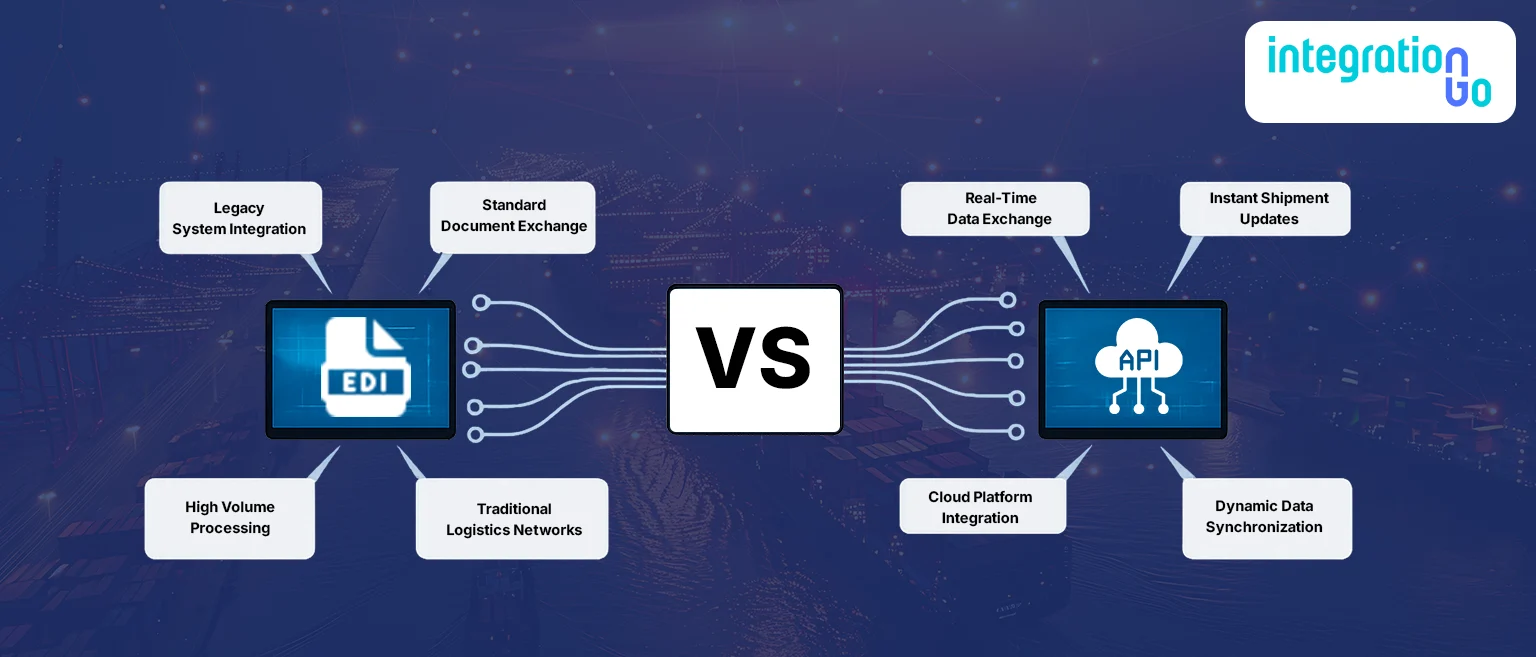
However, EDI messages usually move in scheduled batches, meaning updates are not always real-time. This works well for standardized document exchanges but can feel slow in modern digital environments.
What is API integration in CargoWise?
API integrations represent a newer and more flexible approach to system connectivity. An API acts like a direct communication channel between systems, allowing them to exchange information instantly.
Instead of sending document files periodically, APIs allow systems to request and deliver data in real time.
What makes APIs powerful in Logistics?
- Real-time communication
Systems can instantly retrieve shipment updates or send new data. - Flexible integration
APIs can connect CargoWise with a wide variety of applications. - Event-driven automation
When something changes in CargoWise, other systems can be notified immediately.
This allows logistics companies to create dynamic digital workflows that respond instantly to operational events.
How does API Integration Work in CargoWise?
CargoWise APIs allow businesses to automate many logistics processes.
Here are some common examples.
Order creation automation
Manually creating shipment orders can be time-consuming and prone to mistakes. With APIs, external systems can automatically generate orders in CargoWise based on predefined rules. This saves time and ensures consistent data entry.
Booking creation automation
Managing shipment bookings manually can lead to delays and errors. Using CargoWise APIs, booking requests can be automatically generated and sent to carriers. The system processes bookings faster while reducing manual intervention.
Console formation automation
Shipment consolidation is an essential logistics task. CargoWise APIs can automatically group shipments based on predefined conditions. This improves transportation efficiency and reduces operational costs.
Document upload automation
Logistics operations depend on accurate documentation. CargoWise APIs can automatically upload invoices, packing lists, bills of lading, and other documents to the correct shipment record. This prevents missing files and reduces administrative workload.
Job management and tracking
APIs allow CargoWise to provide real-time job status updates. Operations teams can monitor shipment progress instantly and respond quickly to potential delays.
Customer tracking visibility
Customers expect transparency today. Tracking APIs allow logistics companies to provide real-time shipment tracking information, improving customer confidence and service quality.
EDI vs API in CargoWise Integration
The differences between EDI and APIs become clearer when comparing them directly.
| Feature | EDI Integration in CargoWise | API Integration in CargoWise |
| Data Exchange | Batch-based document messaging | Real-time data exchange |
| Communication Style | Document-focused | System-to-system interaction |
| Speed | Scheduled transmissions | Instant responses |
| Flexibility | Fixed document formats | Highly flexible data requests |
| Integration Cost | Higher setup effort | Generally easier to implement |
| Scalability | Limited expansion | Highly scalable |
| Response Feedback | Limited confirmations | Immediate success/failure response |
| Visibility | Delayed updates | Real-time operational visibility |
When Freight Forwarders Should Use EDI?
EDI still plays a crucial role in logistics. It works best when freight forwarders need to communicate with partners that rely on standardized messaging systems.
EDI is especially common in:
- Airline cargo messaging
- Ocean carrier communication
- Customs documentation
- Large enterprise trading networks
In these environments, EDI provides consistency, reliability, and regulatory compliance.
When API Integrations Make More Sense?
APIs are ideal for companies that want to modernize their logistics operations.
They are particularly valuable when businesses need:
- Real-time shipment visibility
- Customer-facing tracking platforms
- Automated booking workflows
- ERP and finance system synchronization
- Dynamic analytics dashboards
APIs allow systems to interact instantly, which improves operational speed and customer experience.
The Hybrid Integration Model: EDI and API Together
Most logistics companies don’t choose between EDI and APIs.
They use both.
EDI connects CargoWise to traditional logistics networks such as carriers and customs systems.
APIs connect CargoWise to modern platforms such as customer portals, automation tools, and analytics systems.
By combining both technologies, freight forwarders can maintain compatibility with industry standards while building modern digital logistics capabilities.
How IntegrationGo Helps Freight Forwarders Build Reliable CargoWise Integrations that Actually Scale?
Connecting CargoWise to other systems sounds simple on paper, but real-world logistics environments are rarely that straightforward. Every freight forwarder works with different carriers, customs platforms, warehouse systems, finance tools, and customer portals. Without the right integration approach, systems quickly become fragmented and difficult to manage.
This is where IntegrationGo steps in as the integration layer that connects your entire logistics ecosystem.
Instead of building one-off connections, IntegrationGo designs structured integrations that allow CargoWise to communicate smoothly with external systems using the right mix of EDI, API, and middleware architecture. The goal is to turn CargoWise into the central operational hub where shipment data, financial information, and operational updates flow automatically.
When this connection is done correctly, teams stop moving data manually between systems. Shipment orders, booking confirmations, documents, and tracking updates move automatically across platforms.
The result is a logistics environment where operations run faster, and teams spend less time fixing data gaps.
Conclusion
When logistics systems are not connected properly, teams spend valuable time re-entering data, chasing updates, and fixing errors. That’s why the way CargoWise integrates with other systems matters more than ever.
EDI continues to support structured communication with carriers, airlines, and customs, while API integrations bring the speed, automation, and real-time visibility modern logistics teams expect today. Together, they create a connected environment where shipment data moves smoothly across systems and operations run more efficiently. Want to simplify your CargoWise integrations with the right mix of EDI and API connectivity?
Contact us today to build scalable integrations that automate workflows and keep your logistics operations moving without delays.