
Freight operations generate thousands of shipment activities every day, but invoice delays continue to create obstacles across logistics workflows. A shipment may be completed, charges may be finalized, and delivery milestones may be updated, while invoicing still depends on manual processes.
That disconnect creates visibility gaps between operations and finance.
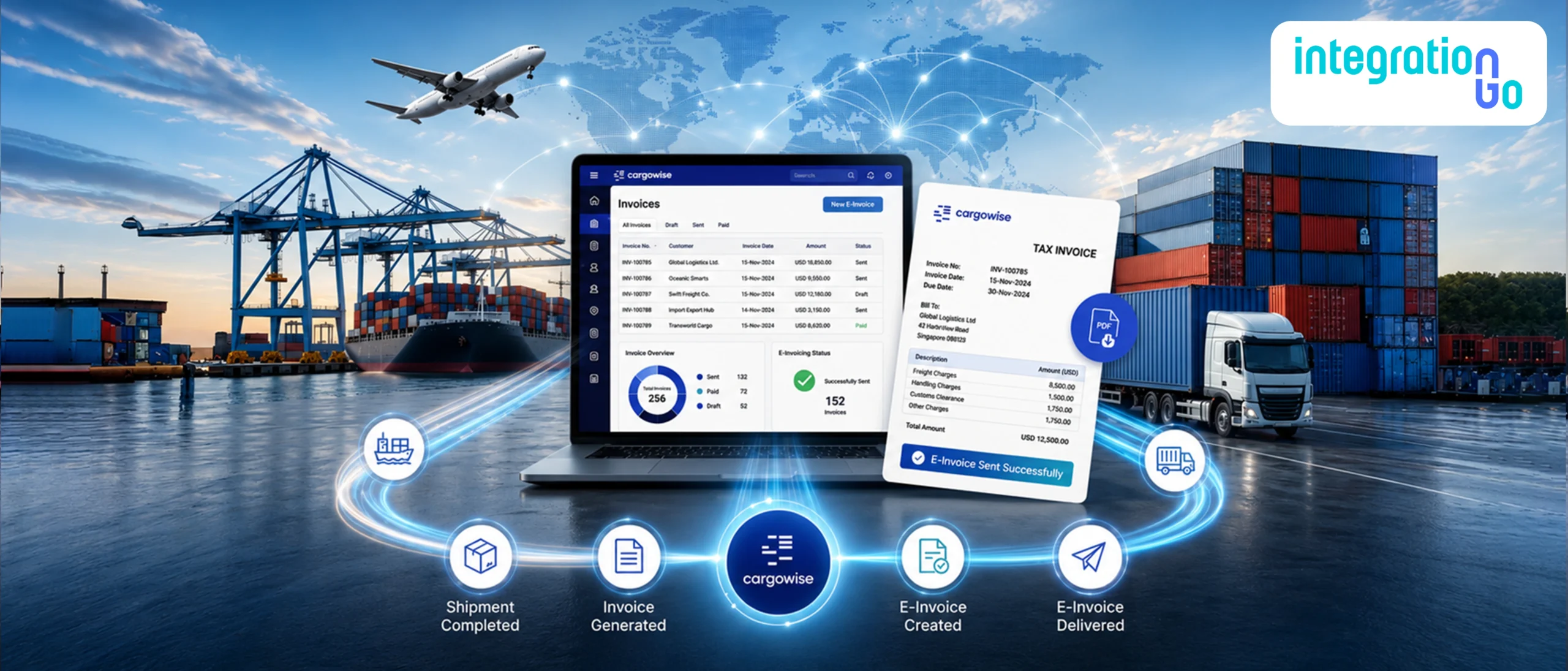
This is where CargoWise E-Invoicing integration becomes valuable. Instead of allowing shipment execution and billing workflows to operate separately, it creates a process where shipment data and invoice activities move together in real time.
What is CargoWise and How does it Support Logistics Financial Workflows?
CargoWise is a cloud-based logistics ERP and freight management platform designed specifically for freight forwarders, customs brokers, and logistics providers. Rather than managing only transportation execution, CargoWise supports the complete shipment lifecycle while maintaining operational and financial visibility.
CargoWise helps businesses manage several critical logistics functions within one environment.
It supports:
- Air, ocean, and road freight forwarding
- Customs and compliance workflows
- Warehouse and inventory activities
- Shipment milestones and tracking
- Operational accounting and invoicing
- Job costing and shipment profitability
One of CargoWise's biggest strengths is its ability to connect shipment execution with financial activities. Every shipment movement, freight charge, warehouse activity, and customs process can be linked directly to operational billing and financial workflows.
For freight forwarders handling high shipment volumes, this creates stronger visibility into shipment profitability and financial performance.
What is E-Invoicing and Why are Logistics Businesses Moving Toward it?
E-invoicing, also known as electronic invoicing, is the process of creating, sending, and processing invoices digitally via connected systems rather than using paper invoices, spreadsheets, emails, or manual data entry.
E-Invoicing in logistics operations can automatically extract shipment-related data from operational workflows, such as freight charges, warehouse fees, customs costs, and customer billing information.
As shipment volume grows, manual invoice processing often creates delays and increases the chance of errors. This is why logistics businesses are increasingly moving toward E-Invoicing because it helps improve:
- Faster invoice generation
- Reduced manual data entry
- Better billing accuracy
- Real-time invoice exchange
- Compliance support
- Reduced reconciliation effort
For freight forwarders and logistics providers, E-Invoicing creates a smoother connection between shipment execution and financial processing.
Where do Shipment-to-Invoice Gaps Usually Start?
System failures rarely cause shipment-to-invoice delays. They occur because operations and financial workflows frequently function independently.
A shipment may be completed in CargoWise, but invoice generation may still depend on manual reviews, spreadsheet updates, or delayed communication between departments.
Over time, this creates several operational issues.
Common challenges include:
- Duplicate invoice entries
- Missing shipment charges
- Delayed customer billing
- Manual reconciliation effort
- Invoice inaccuracies
- Reduced shipment profitability visibility
As shipment volume increases, these small inefficiencies eventually become larger operational obstacles.
How does E-Invoicing Integration Connect Shipment and Billing Workflows?
When CargoWise and E-Invoicing systems operate together, shipment and billing activities become connected rather than separate processes.
Instead of waiting for shipment information to move manually between teams, invoice workflows automatically receive operational updates.
The process becomes much simpler:
Shipment Creation → Shipment Milestones → Charge Allocation → Invoice Generation → Financial Processing
This improves:
- Automatic invoice generation
- Shipment milestone synchronization
- Charge allocation accuracy
- Real-time billing visibility
- Reduced administrative effort
Rather than spending time searching through emails and spreadsheets, teams can focus on shipment execution and customer service.
How does Real-Time Invoice Integration Improve Financial Accuracy?
One of the biggest advantages of E-Invoicing integration is financial consistency.
Without integration, finance teams often spend hours validating shipment charges and reconciling operational records manually.
Real-time integrations improve:
- Invoice processing speed
- Revenue recognition timing
- Billing accuracy
- Shipment profitability visibility
- Financial reporting reliability
- Cash flow visibility
This allows finance teams to spend less time fixing errors and more time focusing on planning, forecasting, and business growth.
How does IntegrationGo Connect CargoWise with E-Invoicing Systems?
Integrating E-Invoicing platforms with CargoWise involves more than simply transferring invoice information from one system to another. Shipment workflows involve transportation charges, operational milestones, financial structures, and validation rules that all need to remain synchronized.
IntegrationGo acts as the intermediary layer that ensures operational and invoice data move smoothly between systems.
The End-to-End Integration process follows a structured workflow:
Project Management
The process begins by aligning operational goals, timelines, and workflow requirements before implementation starts.
Requirements Analysis
Business and technical requirements are gathered to understand how shipment information and invoice workflows should move between systems.
Environment Setup
Servers, CargoWise environments, and communication infrastructure are configured to support secure integration.
Development
EDI connections, eAdaptor workflows, and invoice mapping structures are implemented to ensure accurate synchronization.
Integration Testing
Shipment visibility, invoice generation, workflow functionality, and data accuracy are validated before going live.
Deployment
Solutions are deployed into testing and production environments with minimal operational disruption.
Documentation
Complete architecture diagrams, mapping structures, and user guides are provided for future scalability and support.
How does Connected Invoice Data Support Scalable Logistics Operations?
The more you ship, the more invoices you receive. The larger your logistics operation, the more invoices you receive. Manual processing is hard to maintain and often leads to delays.
Connected invoice data helps companies to improve:
- Faster operational processing
- Reduced administrative workload
- Better shipment profitability visibility
- Improved customer experience
- Stronger end-to-end operational visibility
This creates a more scalable environment where shipment execution and financial processes remain integrated.
Conclusion
Modern logistics operations are more than just moving freight. They rely on information moving rapidly and correctly.
Integration of E-Invoicing with CargoWise helps bridge the gap between shipment activity and financial processing by establishing a connected workflow where operational data and invoice creation flow together in real-time. Schedule a demo today to see how integrated CargoWise and E-Invoicing workflows can simplify operations and create true end-to-end shipment visibility.