
For logistics businesses using CargoWise, France's upcoming e-invoicing reform is more than a finance deadline. It can affect the customer data, tax information, invoice details, and transaction workflows already used across daily operations.
From September 1, 2026, all VAT-liable businesses in France must be able to receive electronic invoices. Large and intermediate-sized businesses must also begin issuing e-invoices and meeting applicable e-reporting obligations from that date.
So, if CargoWise is already at the heart of your billing workflow, the big question is: how do you connect that existing workflow with France's new electronic invoicing requirements without creating more manual work?
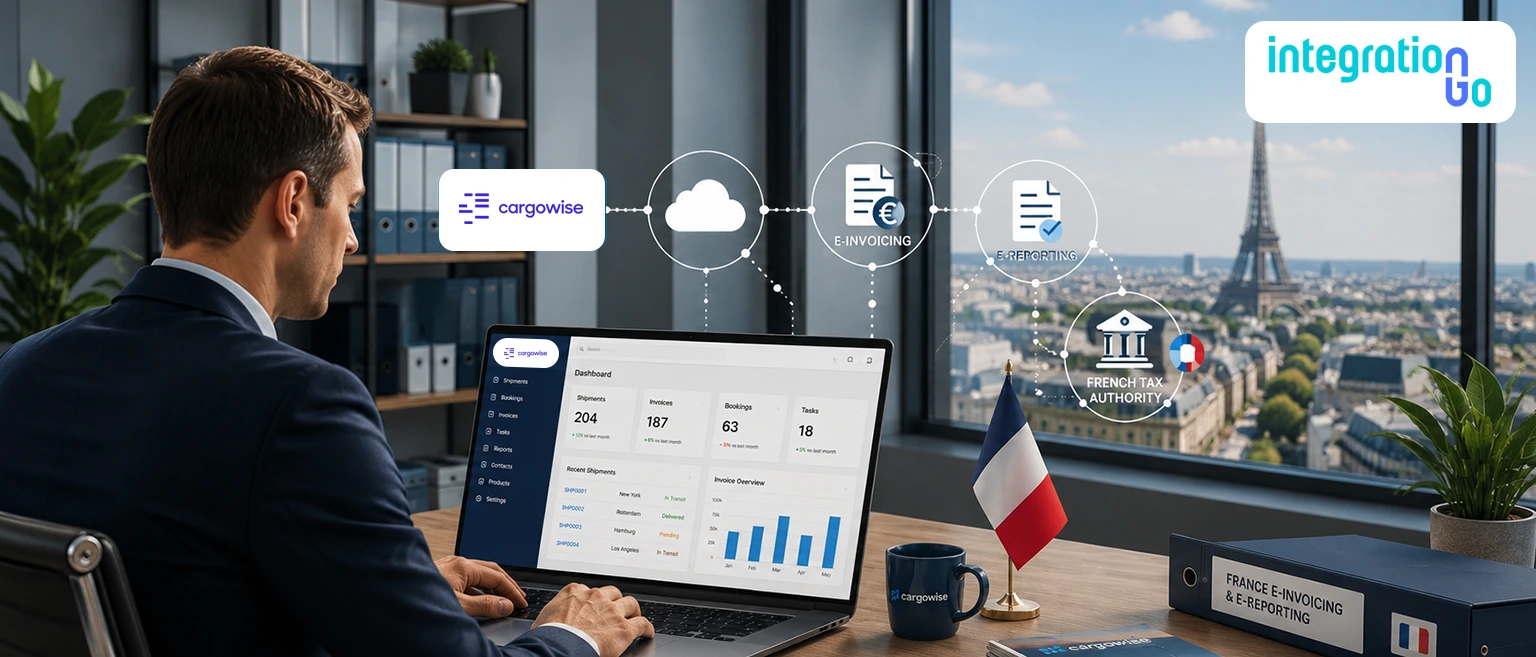
That's where IntegrationGo acts as the middleware, helping connect CargoWise with the appropriate French e-invoicing and e-reporting ecosystem.
What is France's E-Invoicing and E-Reporting Reform?
France is moving toward a structured electronic invoicing model in which businesses exchange invoices through authorized platforms rather than relying on traditional methods such as email attachments.
The reform also introduces e-reporting for certain transactions that fall outside the French e-invoicing flow. These two processes are connected, but they serve different purposes.
E-invoicing generally covers qualifying domestic business-to-business transactions within the French framework.
E-reporting covers specified transactions and, where applicable, payment information for transactions outside that e-invoicing scope.
For CargoWise users, this means invoice information can't simply remain inside the existing billing workflow. The relevant data needs to be identified, structured, validated, and routed through the appropriate electronic process.
France's reform also uses a phased timeline. While the first major obligations begin in September 2026, the exact requirement depends on the size and status of the business.
Why should CargoWise Users Prepare for France's 2026 Requirements?
At first glance, e-invoicing may sound like a finance project. For logistics companies, it reaches further than that.
Think about how a typical freight invoice is created. Customer information, VAT details, charges, references, addresses, currencies, and transaction information may all contribute to the final invoice.
If any of that information is incomplete or inconsistent, the problem may not become visible until the invoice enters the electronic exchange process.
That's why businesses should start by reviewing their existing CargoWise data and workflows.
Questions worth asking include:
- Are customer and supplier records complete?
- Are VAT details accurate?
- Are required business identifiers available?
- Can transactions be classified correctly?
- Are billing and delivery details captured where required?
- How will invoice responses and errors be handled?
France has also introduced additional mandatory invoice information as part of the reform, making data readiness an important part of preparation.
In short, getting CargoWise data ready is just as important as building the integration itself.
What could Happen if Your Invoicing Workflow isn't Ready?
Here's a simple scenario. Your finance team creates an invoice in CargoWise. The charges and total are correct, but one required customer identifier is missing.
The invoice may look perfectly fine to a person reviewing it.
But structured electronic processing doesn't work on appearance alone. The required data needs to be present in the right fields and format.
That can lead to:
- Failed invoice transmission
- Validation errors
- Delayed processing
- Manual corrections
- Additional reconciliation work
- Delayed customer communication
Now imagine handling those issues across hundreds or thousands of invoices. That's when a compliance requirement can quickly become an operational headache. A better approach is to validate the relevant information before it reaches the external platform, so problems can be caught earlier rather than after submission.
How can CargoWise Data be Prepared for French E-Invoicing?
Before connecting systems, businesses should understand what information is already available in CargoWise and where gaps may exist.
Depending on the transaction, relevant information can include:
- Customer and supplier identifiers
- SIREN and VAT information
- Invoice number and date
- Taxable amounts
- VAT rates and amounts
- Transaction category
- Currency
- Billing and delivery information
- Payment information where applicable
The key is not simply collecting more data. It's making sure the right data is accurate, complete, and mapped to the correct fields.
For example, if a required customer identifier exists in CargoWise but is stored in a different field from the one expected by the external platform, the integration needs to know how to map it.
This is where middleware becomes useful. IntegrationGo can sit between the source data in CargoWise and the destination platform, helping validate and transform information before it moves through the French electronic invoicing process.
How does CargoWise Connect with France's E-Invoicing Process?
The overall workflow can be kept fairly straightforward:
Invoice Created in CargoWise
↓
Data Validation
↓
IntegrationGo Middleware
↓
Data Mapping & Transformation
↓
Authorized French Platform
↓
E-Invoice / E-Reporting Submission
↓
Response Received
↓
Status Handled
CargoWise remains the system where the business's invoice and operational information originates. IntegrationGo sits in the middle and manages the data exchange between CargoWise and the external French ecosystem.
This can include validating required information, mapping CargoWise fields, transforming data into the required structure, transmitting the information securely, and handling responses from the connected platform.
France requires businesses to use an authorized platform as part of the new electronic invoicing framework. So the goal isn't to replace CargoWise. It's to connect the existing CargoWise workflow to the new French process in a controlled way.
When does E-Reporting Apply to CargoWise Transactions?
E-reporting deserves separate attention because not every transaction follows the same route. Some transactions fall outside the French e-invoicing scope but can still create reporting obligations. Depending on the transaction, businesses may need to transmit information relating to the transaction and, where applicable, payment details.
For a logistics business, this is particularly important when dealing with different types of customers and cross-border transactions.
A simplified workflow might look like this:
CargoWise Transaction
→ Identify Transaction Type
→ Determine Applicable Route
→ Validate Required Data
→ E-Invoicing or E-Reporting
→ Transmit Through Authorized Platform
The integration therefore needs to understand the nature of the transaction rather than treating every record as a standard French e-invoice.
That helps businesses build a workflow that is both more accurate and easier to manage.
How can IntegrationGo Connect CargoWise to France's E-Invoicing Ecosystem?
This is where IntegrationGo's middleware role comes into play.
CargoWise → IntegrationGo → Authorized French Platform
IntegrationGo provides the connection layer between the existing CargoWise environment and the external electronic invoicing ecosystem.
The middleware can support several important stages:
Data Extraction
Relevant invoice and transaction information is collected from CargoWise.
Validation
Required information is checked before transmission.
Mapping
CargoWise fields are mapped to the structure expected by the connected platform.
Transformation
Information is converted into the required format when necessary.
Transmission
Validated information is securely sent through the appropriate connection.
Response Handling
Acknowledgments, statuses, or errors can be processed and returned to the appropriate workflow. This approach helps logistics businesses adapt their existing CargoWise processes without having to replace the system they already use to manage their operations.
What Needs to be Ready Before September 2026?
Preparation should go beyond simply connecting an API. Before the applicable September 2026 requirements take effect, businesses should review the complete workflow.
1. Confirm Your Requirements
Determine which French e-invoicing and e-reporting obligations apply to each relevant business entity.
2. Review CargoWise Data
Check customer records, VAT information, invoice fields, transaction details, and other required information.
3. Identify Data Gaps
Find missing or inconsistent information before it becomes a submission problem.
4. Select an Authorized Platform
Businesses need to work with the appropriate authorized platform within France's electronic invoicing framework.
5. Define the Data Mapping
Determine how information stored in CargoWise will correspond to the required French data structure.
6. Build and Test the Integration
Test normal invoices, various tax situations, corrections, and applicable e-reporting scenarios.
7. Prepare for Exceptions
A good integration shouldn't only handle successful transactions. Teams should also know what happens when an invoice fails, is rejected, or requires correction.
8. Prepare Users
Finance, operations, and technical teams should understand the new workflow and know who is responsible for resolving issues. Taking these steps early gives businesses room to fix problems before they become production issues.
Why is IntegrationGo the Right Middleware for CargoWise France E-Invoicing?
IntegrationGo acts as the middleware between CargoWise and the French e-invoicing and e-reporting ecosystem. Instead of changing the entire CargoWise workflow, businesses can use the middleware layer to manage data validation, mapping, transformation, secure transmission, and response handling.
The focus is simple: keep CargoWise at the center of your existing logistics workflow while creating the connectivity needed for France's new electronic invoicing requirements.
Conclusion
France's e-invoicing reform is ultimately a change in how business data moves through the invoicing process. For CargoWise users, accurate data, reliable connectivity, testing, and exception handling all need to work together.
Preparing CargoWise for France's 2026 requirements? Contact us to build a middleware-based e-invoicing and e-reporting integration tailored to your business.