
If your CargoWise integrations are working today, you may wonder why you need to think about migration at all. The move from eAdaptor Legacy to eAdaptor Next is not simply a change to the connection setup. It can affect how integrations authenticate, communicate, and exchange data with CargoWise.
Understanding what is changing and what those changes mean for your existing Cargowise integrations can help you move toward the new environment with fewer surprises.
What is eAdaptor Next and Why does it Matter?
eAdaptor Next is the next-generation integration environment for connecting CargoWise with external systems and applications.
The move introduces changes to the underlying integration model, including how connections are authenticated, how systems communicate, and how individual integrations are configured and managed.
For businesses that have relied on eAdaptor Legacy, existing integrations need to be considered based on how they are currently built.
The goal is not simply to move an integration from one environment to another. It is to make sure your connected workflows can continue exchanging the right information through the new environment.
What Changes With eAdaptor Next?
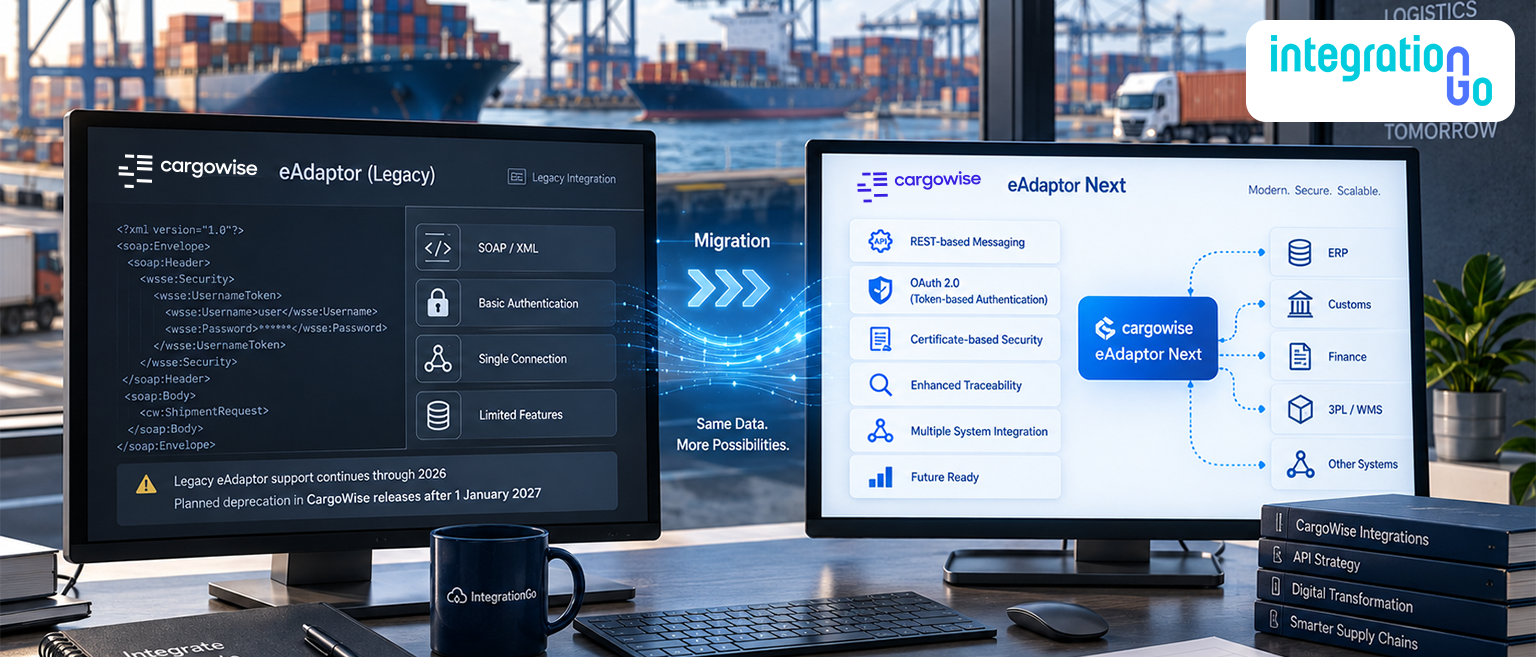
The move to eAdaptor Next introduces changes to authentication, communication, connection management, and data exchange.
- Authentication: eAdaptor Next uses a more controlled access model, including certificates, tokens, and individual credentials for external connections.
- Communication: The environment moves away from the traditional SOAP-based approach toward REST/HTTP and XML-based communication.
- Connection management: Individual integrations have their own connection configuration, access boundaries, authentication setup, and technical ownership.
- Data exchange: UniversalInterchange XML can be exchanged directly without the SOAP envelope used in the Legacy environment.
These changes create a more modern approach to managing connections with CargoWise and can affect how existing integrations need to be adapted.
How could the Migration Affect Your Existing Integrations?
If your integrations are working today, the natural question is, will they continue to work after the move?
That depends on how each integration has been built.
Your current environment may include different endpoints, authentication methods, middleware components, and data flows. Some integrations may require configuration changes, while others that depend heavily on older communication methods may require more significant development work.
For example, an integration built around Legacy-specific communication may not be a simple configuration change. It may need to be adapted or rebuilt to work with the new environment, that is why each existing integration needs to be considered individually rather than assuming every connection will migrate in exactly the same way.
What Advantages does eAdaptor Next Bring to Your Integration Environment?
The move to eAdaptor Next is not only about changing how integrations connect with CargoWise. It also provides a foundation for a more secure, scalable, and modern integration environment.
Key advantages include:
- Stronger security: Certificate-based and token-based authentication provide a more controlled approach to integration access.
- Better connectivity: The new connection model supports connections across multiple business applications.
- Improved traceability: More structured connection and access information can make it easier to identify and resolve integration issues.
- Flexible data exchange: Modern communication methods provide greater flexibility for different data exchange requirements.
- Less reliance on workarounds: A modern integration environment can reduce dependence on complex Legacy-specific configurations.
- Support for automation and AI: eAdaptor Next provides a stronger foundation for API-driven connectivity, automation, AI-enabled workflows, and real-time data exchange.
For logistics teams, this creates a stronger foundation for connected operations as integration requirements continue to evolve.
What could Happen If an Integration is Not Ready?
An integration issue does not always stay an integration issue.
If a connection fails or data stops moving correctly, it can affect the business process that depends on it. Shipment information may not be transferred as expected, automated workflows can be interrupted, and teams may have to fall back on manual work.
The impact can become more noticeable when multiple operational processes depend on the same integration environment.
Addressing affected integrations before the transition can help reduce unexpected disruption and keep important workflows connected.
How can IntegrationGo Support Your eAdaptor Next Migration?
Moving to eAdaptor Next can involve more than changing a few settings. IntegrationGo can work with your existing CargoWise environment to assess the current integrations and determine what needs to change for the new environment.
The support can include:
- Integration assessment: Review your existing CargoWise connections and identify dependencies.
- Migration planning: Determine whether each integration requires configuration changes, adaptation, or redevelopment.
- Data flow review: Check how information currently moves between CargoWise and connected systems.
- Integration development: Modify or rebuild integrations where required for the new environment.
- Testing and validation: Verify that data is exchanged correctly before moving critical workflows.
- Migration support: Help coordinate the transition so important business processes remain connected.
The approach can be based on your actual CargoWise integration environment rather than applying the same migration process to every connection.
From assessment to migration and testing, IntegrationGo can handle the complete eAdaptor Next transition for your CargoWise integrations.
Conclusion: Is Your CargoWise Integration Environment Ready for eAdaptor Next?
The move from eAdaptor Legacy to eAdaptor Next is more than a change in connection technology. It introduces changes to authentication, communication, connection management, and data exchange.
At the same time, it provides a foundation for more secure connectivity, flexible integrations, automation, and future digital workflows.
Understanding these changes and how they affect your existing integrations gives you a clearer path toward the transition and helps reduce the risk of unexpected integration issues.
Planning of moving to eAdaptor Next? Contact us to review your current integrations and develop an end-to-end CargoWise Integration strategy for a smooth transition.