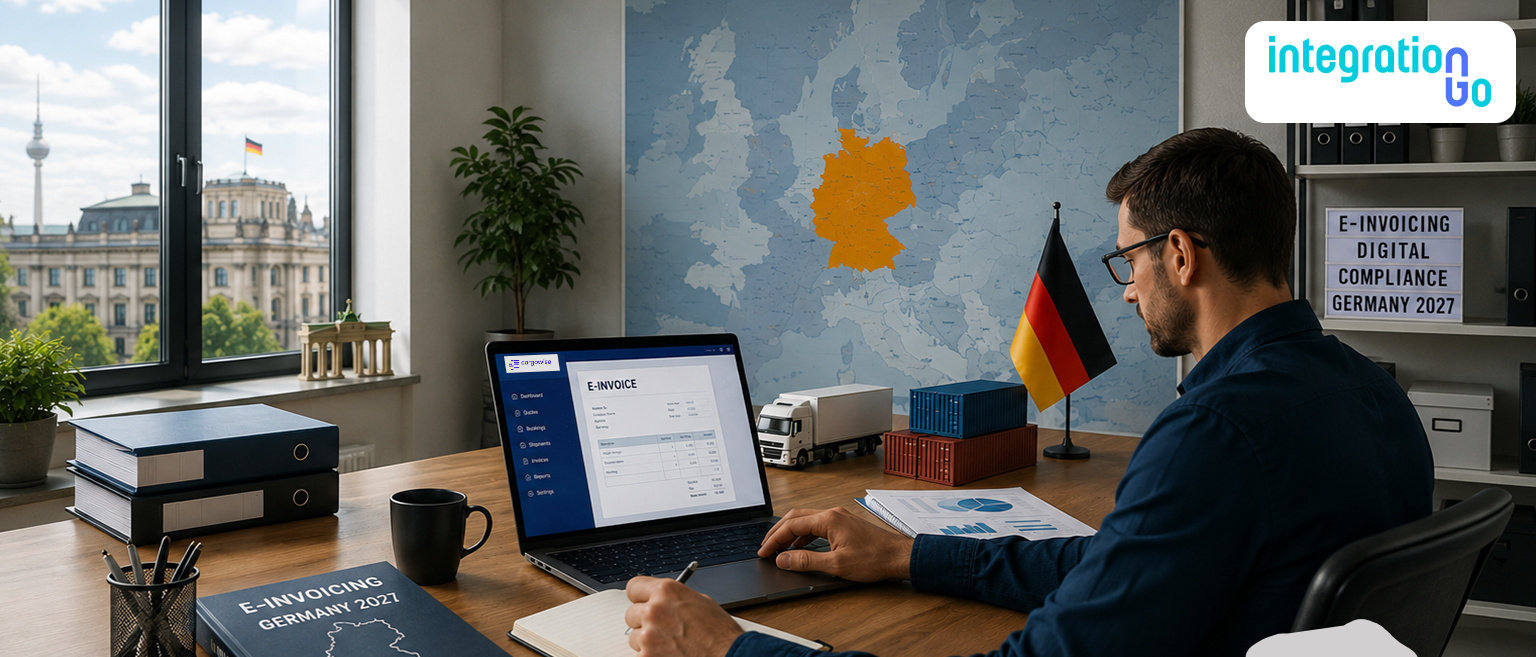

For logistics businesses using CargoWise, Germany's e-invoicing transition is not simply about replacing a PDF with an electronic file. The bigger challenge is making sure the invoice data created in CargoWise can be structured, validated, exchanged, and managed correctly.
Germany's mandatory e-invoicing rules for applicable domestic B2B transactions began on January 1, 2025, with transitional arrangements continuing through 2026 and, for certain businesses, into 2027.
That gives logistics businesses time to prepare, but it also creates an important question: Is your CargoWise billing workflow ready for the next stage?
With IntegrationGo acting as middleware, businesses can connect their CargoWise environment with the required e-invoicing workflow without turning the transition into another manual process.
What is Germany's E-Invoicing Mandate and Why does it Matter?
Germany's new rules require qualifying domestic B2B invoices to move toward structured electronic invoicing. An e-invoice must contain structured electronic information that can be processed automatically. A regular PDF sent by email does not, by itself, meet the new definition of an e-invoice.
The transition is phased. Since January 1, 2025, businesses must be able to receive e-invoices, while businesses issuing invoices have transitional options through 2026. Businesses with prior-year turnover of up to €800,000 can have an extended transition for certain invoices through the end of 2027.
For logistics companies, this matters because an invoice is connected to much more than finance. Freight charges, customer information, taxes, shipment references, and other billing details can all feed into the final invoice.
So the real question isn't simply whether CargoWise can create an invoice.
It's whether the information behind that invoice is ready for structured electronic
processing.
Why should Logistics Businesses Start Preparing for Germany's E-Invoicing Changes?
A logistics invoice can bring together information from several parts of the shipment and billing process.
Think about a typical freight transaction. Your team may need to bill transportation, handling, warehousing, customs-related services, or other charges. The invoice may also carry customer references, tax information, currency details, and shipment-related information.
When that information is already flowing through CargoWise, moving to structured e-invoicing shouldn't mean creating a completely separate manual process.
Preparing early gives businesses time to:
- Review their existing CargoWise billing workflow
- Check the quality of invoice and customer data
- Identify information that needs to be mapped
- Decide how invoices will be exchanged
- Test different billing scenarios
- Prepare for exceptions and corrections
Germany's transitional provisions provide time to adapt, but using that time wisely can make the eventual transition much smoother.
What could Germany's E-Invoicing Changes Mean for Your CargoWise Workflow?
Here's where the change becomes real for a logistics team. Imagine your finance team creates an invoice in CargoWise. The customer is correct, the charges are correct, and the invoice total looks right.
But an electronic invoice isn't judged only by what someone can see on a screen.
The underlying structured data needs to contain the required information and follow the applicable electronic format requirements. Germany recognizes formats based on EN 16931, including XRechnung and ZUGFeRD 2.0.1 and later, subject to the applicable conditions.
That means your CargoWise workflow may need to account for information such as:
- Customer and supplier details
- VAT information
- Invoice number and date
- Invoice line details
- Tax amounts
- Currency
- Payment information
- Relevant references
If that information isn't available or mapped correctly, the invoice may need manual attention.
For a logistics business handling a high volume of invoices, that can quickly turn into more rework, slower billing, and unnecessary back-and-forth between finance and operations.
Which CargoWise Invoice Data Needs to be Ready for Germany?
Before building the integration, businesses should take a close look at the data already used by CargoWise to create invoices.
The goal is simple:
Know what data you have, where it lives, and how it needs to move.
Depending on the transaction, businesses should review:
- Customer and supplier information
- VAT and tax details
- Invoice number and date
- Service and charge information
- Taxable amounts
- VAT rates and amounts
- Currency
- Payment terms
- Relevant customer or shipment references
This is where data mapping becomes important.
For example, if a customer reference is stored in one CargoWise field but needs to appear in a specific structured invoice field, the integration needs to know that relationship.
Germany's Federal Ministry of Finance also recommends validation because it can identify missing or logically inconsistent information before an e-invoice is exchanged.
So before focusing on the connection itself, make sure the source data is accurate and complete.
How does Invoice Data Move from CargoWise to Germany's E-Invoicing Process?
A typical CargoWise E-Invoicing Integration workflow can follow this path:
Invoice Created in CargoWise
↓
Data Validation
↓
IntegrationGo Middleware
↓
Data Mapping & Transformation
↓
E-Invoice Prepared in the Required Structure
↓
Electronic Exchange
↓
Response / Status Handling
CargoWise remains the source of the relevant logistics and billing information.
IntegrationGo sits in the middle as the middleware layer, helping move that information into the appropriate electronic invoicing workflow.
It can support:
Validation → Check whether the required information is available.
Mapping → Match CargoWise data with the required invoice structure.
Transformation → Convert information into the appropriate electronic format when required.
Transmission → Move the prepared invoice through the selected exchange method.
Response handling → Process responses, errors, or other statuses.
Germany does not require one single transmission method for every domestic B2B e-invoice. Different exchange methods can be used when the applicable requirements are met.
That flexibility means businesses can build an integration around their existing CargoWise environment instead of forcing their teams into an entirely new billing process.
What Happens When an E-Invoice is Rejected or Needs Correction?
A good integration isn't only about successful invoices. Real-world logistics billing involves corrections. A customer may question a charge, a tax detail may need adjustment, or an invoice may need to be replaced or corrected.
That's why exception handling should be part of the workflow from day one.
For example:
Invoice Created
→ Validation Issue
→ Problem Identified
→ Data Corrected
→ Invoice Reprocessed
The important thing is that users can quickly understand:
- What went wrong
- Which information needs attention
- Who needs to fix it
- Whether the invoice can be reprocessed
- How the correction is tracked
This helps prevent failed invoices from becoming another hidden manual task for the finance team.
For logistics businesses, that's a big deal. When invoice volumes are high, even a small percentage of exceptions can create a significant workload.
How does IntegrationGo Integrate CargoWise with Germany's E-Invoicing Process?
IntegrationGo acts as the middleware between CargoWise and the business's Germany e-invoicing workflow.
Rather than replacing CargoWise, IntegrationGo provides the connection layer needed to move relevant invoice information between the existing CargoWise environment and the external electronic invoicing process.
The integration can support:
CargoWise Data → Validation → Mapping → Transformation → Electronic Exchange → Response Handling
This helps businesses maintain their existing logistics and billing workflows while creating a more structured path for electronic invoicing.
The goal isn't simply to connect two systems.
It's to create a reliable flow of invoice information that reduces manual intervention and gives teams a clearer way to manage both successful transactions and exceptions.
What should Businesses Have in Place Before January 2027?
By January 2027, businesses shouldn't be asking where to begin. They should already have their process tested and ready for the requirements that apply to them.
A practical preparation plan includes:
- Review the applicable German requirements for your business.
- Audit CargoWise invoice data for completeness and accuracy.
- Identify data gaps before they become processing issues.
- Define field mappings between CargoWise and the e-invoicing workflow.
- Determine the appropriate exchange approach for your business.
- Configure the IntegrationGo middleware connections.
- Test different invoice scenarios, not just a standard invoice.
- Test corrections and exceptions so failed transactions can be handled properly.
- Train finance and operations teams on the new workflow.
- Move the tested integration into production when your applicable transition period requires it.
One important point: January 2027 is not a universal German e-invoicing issuing deadline for every business. The transition depends on factors including the invoice date and the issuer's previous-year turnover. Businesses should determine the timeline that applies to their own circumstances.
The earlier the preparation starts, the more time teams have to clean up data, test workflows, and fix issues without putting daily billing operations under pressure.
Conclusion
Germany's e-invoicing transition is not simply about changing how an invoice looks. For logistics businesses using CargoWise, it's about making sure invoice data, workflows, and electronic exchange processes work together.
With IntegrationGo as the middleware, businesses can connect CargoWise with their Germany e-invoicing workflow while keeping their existing logistics operations at the center.
Ready to get CargoWise prepared for Germany's e-invoicing requirements? Contact us to discuss a middleware-based integration built around your logistics workflow