
Imagine your operations team has arranged an international shipment. The cargo is ready, the transport booking is confirmed, and the shipping documents are being prepared.
But before the shipment can proceed, your compliance team discovers that the consignee requires additional screening or that the goods may need an export license.
Now your team needs to check the shipment details, confirm the compliance requirements, and wait for the issue to be resolved. If this happens close to the planned departure, the shipment could miss its scheduled movement.
For freight forwarders using CargoWise, situations like this highlight an important question: Can your team identify potential trade compliance issues before they interrupt shipment operations?
When shipment information is maintained in CargoWise and trade compliance checks are handled separately in SAP Global Trade Services (SAP GTS), your team may need to transfer information manually and coordinate updates between systems.
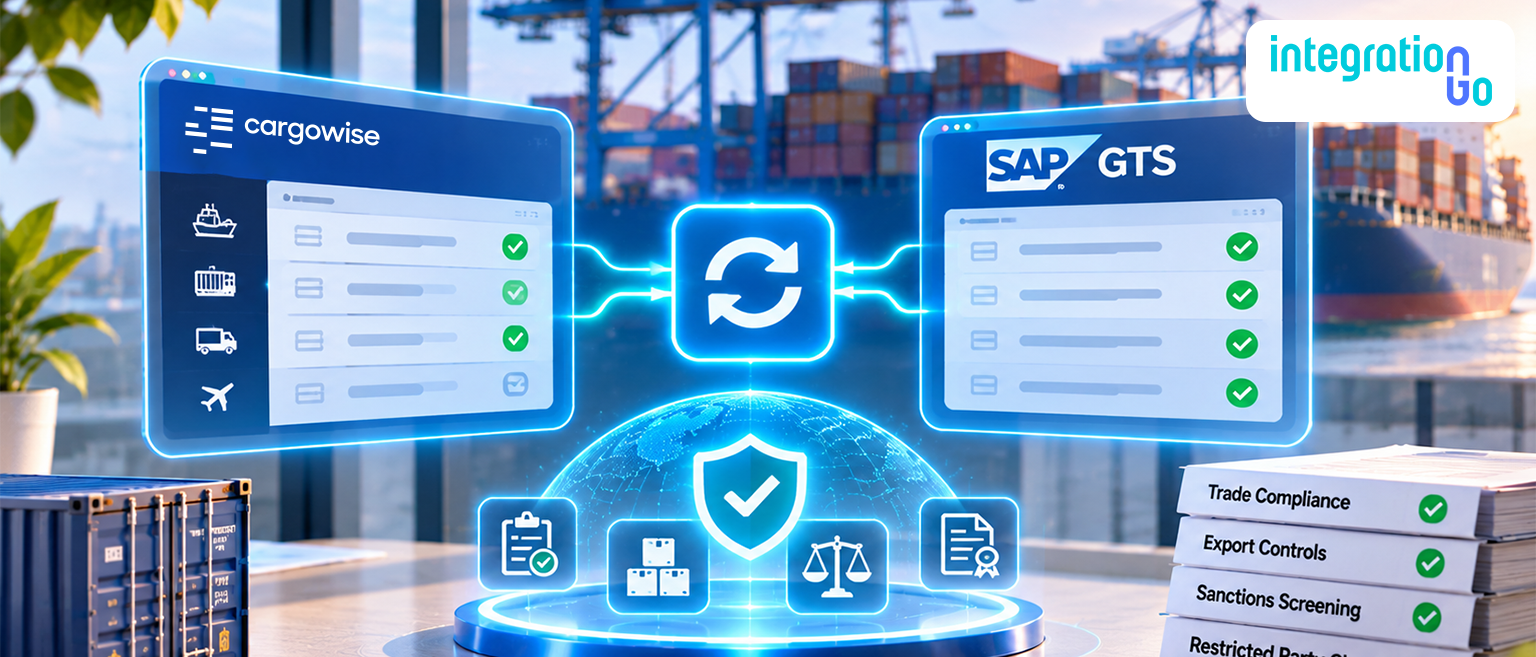
Integrating CargoWise with SAP GTS can help connect these processes by exchanging relevant shipment information, supporting earlier compliance checks, and making it easier for your team to identify issues requiring attention.
Let's explore how this integration works and what it means for your daily freight forwarding operations.
What is SAP GTS, and Why does it Matter for Freight Forwarders?
SAP Global Trade Services (SAP GTS) is a software solution that helps businesses manage international trade compliance, customs processes, and trade-related regulatory requirements.
When goods move between countries, businesses may need to verify whether their trading partners are subject to restrictions, whether products require export licenses, and whether the shipment meets applicable trade regulations.
SAP GTS supports these activities through several capabilities:
- Compliance Management: Supports restricted-party screening, sanctions and embargo checks, export control requirements, and license management.
- Customs Management: Supports customs declaration processes, customs-related procedures, and electronic communication with supported customs authorities.
- Preference Management: Helps businesses manage preferential origin requirements, trade agreements, and supplier declarations.
For freight forwarders, SAP GTS can be relevant when they coordinate shipments for customers whose trade compliance processes are managed through the system.
However, the responsibilities are not always the same for every shipment. The exporter, importer, or another authorised party may be responsible for specific compliance decisions, while the freight forwarder coordinates the operational information and shipment activities.
The challenge arises when the shipment details needed for these checks are available in CargoWise but must be entered or verified separately in SAP GTS.
How can a Trade Compliance Issue Delay a Shipment in CargoWise?
Consider a freight forwarder handling an export shipment of industrial equipment.
The operations team creates the shipment in CargoWise and records the shipper, consignee, destination, cargo description, and transport details.
The shipment appears ready to move, but the customer's compliance process requires restricted-party screening and a review of whether the equipment is subject to export licensing requirements.
Without a connected workflow, several things may happen.
The compliance team requests shipment details from operations. Someone extracts the information from CargoWise and enters it into SAP GTS. If the product classification or consignee information is incomplete, the compliance team must request clarification.
Meanwhile, the operations team may not know whether the checks are complete or whether additional information is required.
The shipment can remain pending while the teams exchange emails and wait for a decision.
The problem is not necessarily that the compliance checks take too long. It is that the information needed to perform those checks may arrive late, be incomplete, or remain disconnected from the shipment workflow.
This is where CargoWise and SAP GTS integration can help.
By exchanging the required information earlier, an integration can support compliance review before the shipment reaches a critical operational stage.
What Information Needs to Move Between CargoWise and SAP GTS?
Not every field recorded in CargoWise is needed for a compliance check. The information exchanged depends on the type of transaction, applicable regulations, SAP GTS configuration, and the agreed integration scope.
For example, the following information may be relevant:
1. Business Partner Details
Shipper, consignee, customer, supplier, and other relevant trading-party information may be required for restricted-party screening.
Accurate names, addresses, and identification details can help the compliance team investigate potential screening matches.
2. Product and Commodity Information
Product descriptions, commodity classifications, country of origin, and relevant export control classifications may be needed to assess applicable requirements.
A general cargo description may not be sufficient for an export control decision. The responsible team may need more detailed product information.
3. Shipment and Transaction Details
Origin, destination, shipment references, transaction parties, and relevant transport information can help connect compliance checks with the correct shipment.
4. Customs and Licensing Information
Depending on the process, the integration may need to exchange customs-related data, license references, or other trade documentation details.
For example, a product may require an export license that must be verified before the transaction proceeds.
The important point is that integration does not automatically make incomplete information correct.
Your team still needs accurate master data, valid classifications, and appropriate compliance rules. The integration helps make the required information available to the relevant system without unnecessary re-entry.
How does CargoWise and SAP GTS Integration Work When a Compliance Issue is Identified?
To understand the value of integration, let's return to the industrial equipment shipment.
Suppose the consignee information requires additional screening review before the shipment can proceed.
A configured CargoWise and SAP GTS integration could support the following workflow.
Step 1: The Shipment is Created in CargoWise
Your operations team records the shipment details in CargoWise, including the trading parties, destination, and relevant cargo information.
These details provide the starting point for the compliance process.
Step 2: Relevant Information is Sent to SAP GTS
The integration transfers the required information from CargoWise to SAP GTS through the configured interface.
Before transmission, the middleware may check whether mandatory fields are available and transform the information into the required format.
If important information is missing, the workflow can identify the data issue for correction.
Step 3: SAP GTS Performs the Configured Checks
SAP GTS processes the information according to the applicable compliance rules and maintains screening data.
For example, it may identify a potential restricted-party match involving the consignee.
This does not automatically mean the customer is prohibited from receiving the shipment. A screening result may require further investigation to determine whether it is a genuine match or a false positive.
Step 4: The Issue is authorized and sent for Review
Depending on the configured integration, the relevant compliance result or status can be made available to the responsible team or returned to a connected workflow.
The compliance team can then investigate the potential match, verify the consignee's information, and determine the appropriate next action.
If the issue concerns a missing export licence or incomplete product classification, the team may need additional documentation or confirmation from the responsible trading party.
Step 5: The Shipment Proceeds According to the Compliance Decision
Once the authorised compliance team has completed its review, the appropriate status can be recorded and communicated through the agreed workflow.
If the shipment is permitted to proceed, operations can continue with the necessary arrangements.
If the issue remains unresolved, the shipment may need to remain pending until the applicable requirements are satisfied.
The integration helps coordinate the information and status updates, but it does not replace authorised compliance decisions.
The exact checks, status responses, and operational controls depend on the SAP GTS implementation and the interfaces configured with CargoWise.
What should Your Team do When SAP GTS Flags a Compliance Exception?
A compliance exception does not always mean the shipment must be cancelled. It means something requires attention before the relevant process can continue.
Your team needs to understand the reason for the exception and who is responsible for resolving it.
| Compliance issue | What your team should check |
| Potential restricted-party match | Verify trading-party details and refer the result for authorized compliance review. |
| Missing export license | Confirm the applicable licensing requirement and obtain the necessary documentation. |
| Incomplete product classification | Request accurate classification details from the responsible partyauthorized |
| Incorrect destination information | Review the shipment record and correct the relevant data. |
| Missing mandatory information | Complete the required fields and resubmit the information for processing. |
A structured exception-handling process helps avoid situations where operations simply wait for an update without knowing what is missing.
It also helps your team distinguish between an integration error, a data quality issue, and an actual compliance concern.
These situations require different actions.
For example, an incorrect field mapping should be addressed by the integration support team, while a potential sanctions match must be reviewed by authorised compliance personnel.
By making this distinction clear, freight forwarders can improve coordination without compromising the necessary compliance controls.
How can CargoWise and SAP GTS Integration Improve Your Daily Operations?
The main benefit of integration is not simply moving information from one system to another.
It is helping your teams work with the same relevant shipment information while managing compliance requirements at the appropriate stage.
Earlier Less Repeated Data Entry
Operations teams can avoid manually copying the same available shipment and trading-party details into separate systems where the integration supports data reuse.
Clearer Exception Handling
A structured workflow can help the responsible team understand whether a shipment requires additional data, compliance review, or technical support.
Better Coordination Between Teams
Operations and compliance personnel can work from connected information instead of repeatedly requesting shipment details through email.
More Consistent Records
Mapped and validated data exchanges can reduce discrepancies caused by manually entering the same information in multiple systems.
These improvements can help reduce avoidable administrative delays. However, integration cannot eliminate regulatory reviews, guarantee customs clearance, or override mandatory compliance requirements.
How can IntegrationGo Help You Connect CargoWise with SAP GTS?
Integrating CargoWise and SAP GTS involves more than establishing a technical connection.
Both systems need to exchange the correct information at the correct stage, and the integration must account for missing data, validation errors, and compliance exceptions.
IntegrationGo acts as middleware between CargoWise and SAP GTS, supporting the exchange and transformation of relevant information based on the agreed business workflow.
Our integration approach includes the following stages.
1. Understand Your Existing Workflow
We review how your team manages shipment information in CargoWise and how the relevant compliance processes operate in SAP GTS.
This helps determine when information should be exchanged, which data is required, and which teams are responsible for reviewing exceptions.
2. Map the Required Data
CargoWise and SAP GTS use different data structures and business objects.
We identify the relevant fields and configure the mappings needed to exchange information in the required format.
This stage also helps identify information that may not be available in CargoWise and must come from another authorised source.
3. Configure the Integration Interfaces
We establish the supported interfaces and configure the middleware for data exchange, transformation, and validation.
Depending on the systems and implementation requirements, this may involve API integration or other supported connectivity methods.
The technical approach is determined by the available CargoWise and SAP GTS interfaces and the agreed integration scope.
4. Test Normal and Exception Scenarios
Testing should cover more than successful data transfers.
For example, we can test how the integration handles missing mandatory fields, incorrect mappings, rejected messages, and interrupted communication.
Where supported by the configured systems, compliance-related status responses can also be tested to confirm that the appropriate information reaches the intended workflow.
5. Support Go-Live
During deployment, we help verify that the configured data exchange works as expected and that relevant teams understand the integration workflow.
This includes reviewing initial processing issues and resolving technical problems identified during go-live.
6. Monitor the Integration
After deployment, integration monitoring helps identify failed transmissions, processing errors, and other communication issues.
This supports more reliable information exchange between CargoWise and SAP GTS as operational requirements evolve.
Our goal is to help freight forwarders connect their shipment operations with the relevant trade compliance processes through a structured, maintainable integration workflow.
Conclusion
A shipment delay caused by a compliance issue is not always avoidable. Regulatory checks, license requirements, and authorised reviews remain necessary parts of international trade.
However, delays caused by missing information, repeated data entry, and poor coordination between systems can often be reduced.
CargoWise and SAP GTS integration can help make the required shipment information available earlier, support structured compliance checks, and improve how teams respond when an issue needs attention.
For freight forwarders, the real value is knowing what information is missing, which team needs to act, and whether the relevant compliance process has been completed before the shipment moves forward.
Looking to integrate your CargoWise shipment operations with SAP GTS? Contact us to discuss your integration requirements and explore a workflow suited to your business.