
Across global logistics, companies lose hundreds of hours each month because operational data, customs details, and financial records sit in different systems. A single missing milestone can delay a shipment. A mismatched invoice can slow cash flow. A manual customs entry can hold an entire container.
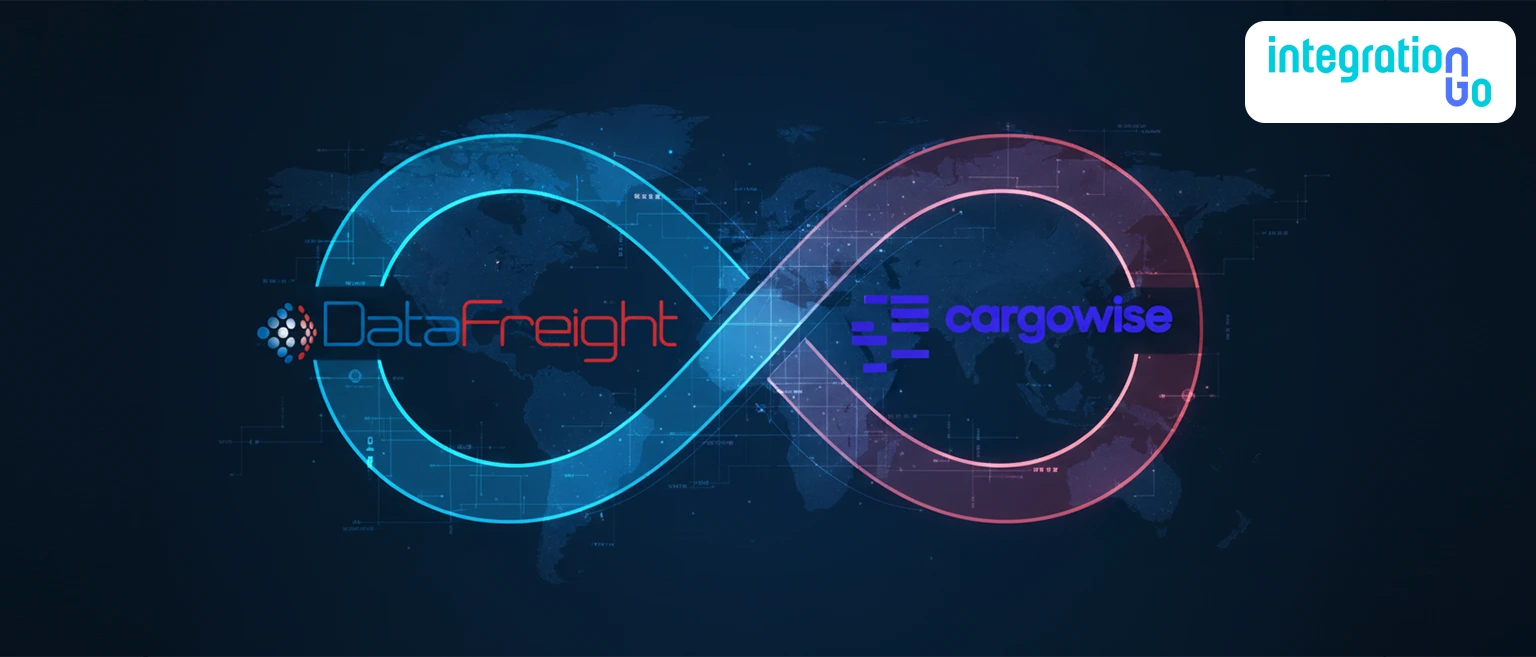
That’s where DataFreight and CargoWise become a powerful combination, one manages UK customs, forwarding, warehousing, and documentation, while the other acts as a full global logistics ERP. When Integrated, they give freight forwarders the speed, visibility, and workflow accuracy required to compete in today’s high-volume, high-pressure logistics environment.
Let’s explore the blog to understand what DataFreight really is, why integrating it with CargoWise creates real value, and how forwarders can supercharge daily operations by seamlessly bridging the two platforms.
What is DataFreight Software?
DataFreight is a long-standing UK freight management and customs clearance platform used by forwarders, NVOCCs, customs brokers, and logistics operators. It is well-known for its HMRC-integrated customs functionality and for supporting forwarding, warehousing, documentation, and compliance needs in the UK market.
Core Features of DataFreight
1. Customs Compliance
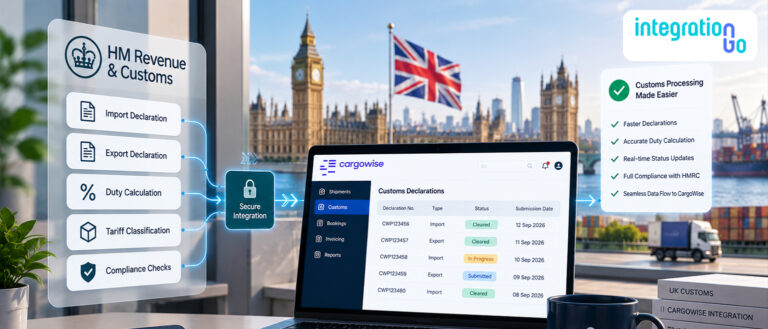
DataFreight connects directly with HMRC (HM Revenue & Customs) through the Customs Declaration Service (CDS), the UK government’s modern digital platform for handling customs compliance. CDS is HMRC’s official system for submitting import and export customs declarations, replacing the older CHIEF system and becoming the mandatory channel for all UK customs filings
- Automated import and export declarations
- MRN generation
- Duty/VAT calculation
- Status updates and customs messaging
2. Freight Forwarding Operations
Helps forwarders manage shipments across air, sea, and road, including:
- Quoting and booking
- Managing transport documents
- House/Master bill creation
- Cargo tracking
- Shipment file management
3. Warehousing & Inventory Control
Supports bonded warehouses and inventory-linked customs processes such as:
- Stock reporting
- Duty suspense regimes
- Goods movement records
4. Reporting & Regulatory Documentation
Produces structured logistics documents and compliance paperwork required for HMRC and international authorities.
5. Integration Support
Although not natively integrated with all systems, DataFreight can exchange data via:
- XML
- CSV
- Flat-file scheduling
- API endpoints (varies by module)
This makes integration with CargoWise not only feasible but highly beneficial.
What is CargoWise?
CargoWise is a global logistics cloud-based ERP used by more than 16,500 logistics companies across 180+ countries. It centralizes freight forwarding, customs, warehousing, transportation, accounting, and compliance into one cloud platform.
Key Modules CargoWise Provides
- Forwarding (air, sea, road)
- Customs & brokerage
- Warehouse management (WMS)
- Transport management (TMS)
- Integrated accounting
- Customer visibility portals
- Workflow automation
- AI-powered classification, workflows & exception alerts
CargoWise is built for end-to-end visibility, eliminating data silos and streamlining operational efficiency.
How CargoWise Integration Supercharges Freight Forwarding Operations?
Integrating DataFreight with CargoWise gives forwarders a unified operational and customs ecosystem. Here’s how it boosts accuracy, speed, and performance:
1. Real-Time Visibility Across Every Milestone
Forwarders gain a single source of truth for:
- Shipment status
- Customs declaration progress
- Warehouse updates
- Job costing & P/L
- Customer notifications
Instead of toggling between systems, teams access everything in CargoWise, and DataFreight keeps customs compliant in the background.
2. Multi-Modal Transportation in One Unified System
CargoWise handles air, ocean, and road shipments within one platform:
- Air freight bookings
- Ocean schedules & VGM
- Truck routing & planning
- Consolidation management
Integrating DataFreight ensures customs clearance milestones are automatically pushed into each job file.
3. Direct Carrier & Airline Connectivity
CargoWise offers deep carrier integrations, such as:
AirlineConnect
- Live rates
- Allotment handling
- Flight schedules
- Real-time booking confirmations
Ocean Carrier APIs
- Booking submissions
- Status updates
- EDI document exchange
DataFreight complements this with customs clearance for UK-bound cargo.
4. Electronic Port Messaging
CargoWise connects with global Port Community Systems (PCS), enabling:
- Real-time container status
- Vessel ETA updates
- Customs hold/release notifications
By integrating DataFreight’s CDS submissions, users keep operational and regulatory data synchronized.
5. Workflow Automation that cuts Hours of Manual Work
CargoWise workflows automate tasks like:
- Job creation
- Invoice generation
- Tracking updates
- Exception alerts
- Document sharing
Why DataFreight Needs to Integrate with CargoWise?
Forwarders need CargoWise and DataFreight to collaborate because they address completely different aspects of the logistics task. The operational engine for international freight forwarding, CargoWise manages jobs, milestones, invoicing, transport planning, warehousing, and customer visibility. On the other hand, DataFreight is designed for UK customs clearance, with a focus on government-regulated workflows, bonded warehousing, CDS declarations, and duty computations.
Teams must continuously retype job data, manually match tariff codes, and follow clearance updates across two platforms when these systems function independently. Port delays, needless labor, and an increased chance of customs rejection result from this. By allowing the operational ERP to feed customs data, integrating DataFreight with CargoWise eliminates these issues.
What Results can You Expect After Integration?
Once DataFreight and CargoWise are integrated, logistics teams see improvements almost immediately. Customs clearance speeds up because declarations flow directly from CargoWise job files into DataFreight without any retyping, reducing clearance time from days to just hours. Manual workload drops sharply, often by 60–80%, as tariff codes, values, and commodity details transfer automatically. Error rates also fall dramatically, with forwarders reporting up to 90% fewer declaration issues due to consistent data mapping and automated validation.
Visibility improves MRNs, route statuses, document checks, and release messages return instantly to the CargoWise job file, helping customer service teams act quickly and avoid costly delays. Managers gain clearer margin insight because customs and operational data finally align within a single ecosystem.
In short, this integration delivers what manual processes never can, faster clearances, cleaner compliance, smoother workflows, and stronger operational control.
Conclusion
When CargoWise and DataFreight operate separately, both systems perform well, but the moment shipment data needs to move between operations and customs, the cracks begin to show. Duplicate entries, mismatched values, late submissions, and delayed MRNs become daily obstacles.
If you’re ready to eliminate delays, simplify customs workflows, and finally connect your clearance engine to your operational ERP, IntegrationGo makes it happen smoothly and securely. Our team builds the exact DataFreight and CargoWise integration you need with clean data flow, automated declarations, and real-time visibility from job file to customs release. Want to see how fast your operations can run with a fully integrated system? Book a demo to call with IntegrationGo today and experience the difference of true end-to-end integration.