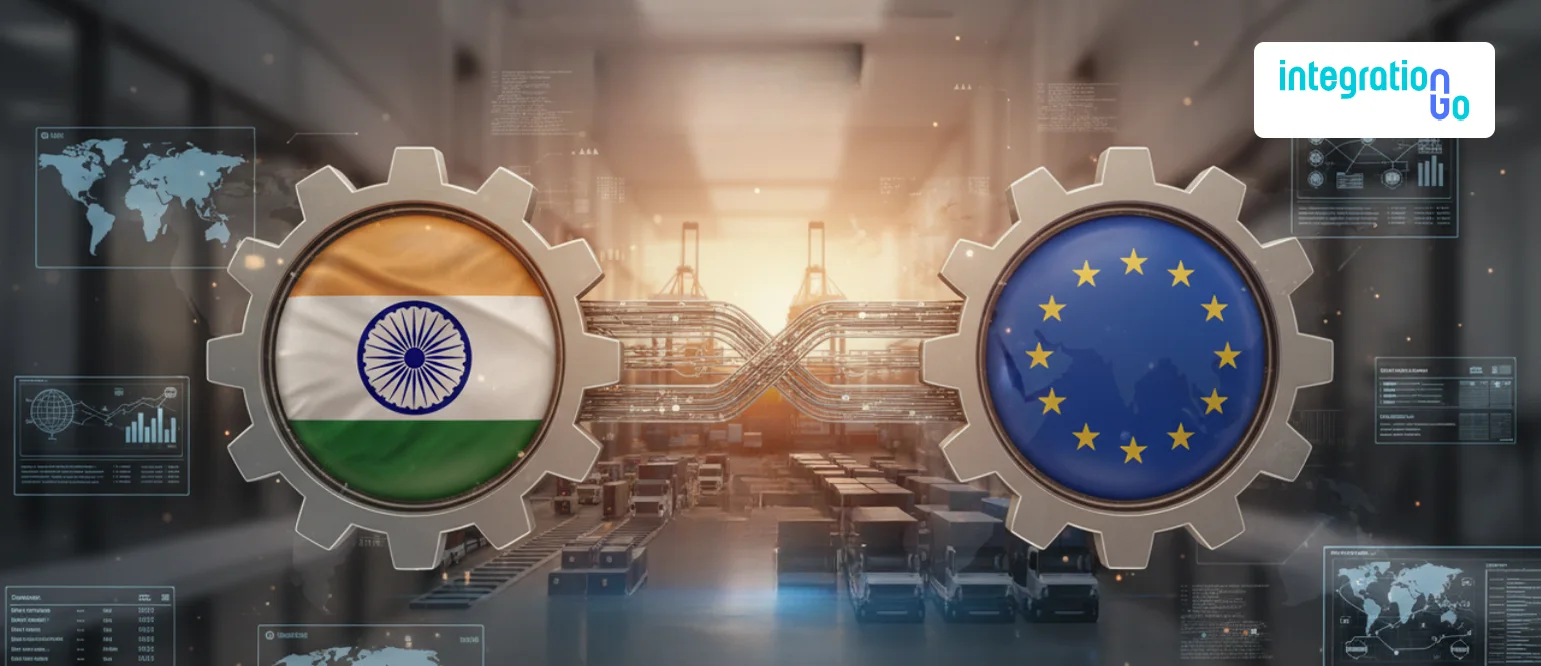

More than 99% of India’s exports to Europe will soon move with zero or near-zero tariffs, that single number changes everything.
In 2024 alone, India–EU merchandise trade crossed USD 136 billion, and services trade added another USD 83 billion. With the India–EU Free Trade Agreement now concluded, trade volumes are expected to surge across every major EU customs gateway, Germany, France, Belgium, the Netherlands, Spain, and beyond
But here’s the part many businesses underestimate: tariff reduction doesn’t remove customs complexity, it amplifies it.
When trade picks up, customs filings increase, and documentation scrutiny tightens. Authorities expect statements that are speedier, cleaner, and fully traceable.
This is where customs integration becomes important, rather than pricing, become the actual differentiation.
Understanding the India–EU Free Trade Agreement
At its core, the India–EU Free Trade Agreement is designed to remove tariff barriers and create predictable market access between the world’s second-largest and fourth-largest economies.
From a customs perspective, the agreement delivers three major shifts:
- 99.5% of Indian exports by trade value receive preferential access into the EU
- 97.5% of EU exports receive tariff concessions in India
- Self-certification and structured origin rules become central to clearance
What this means in practice is not “less customs work,” but more customs activity at a higher speed.
Every shipment still needs:
- Accurate classification
- Correct valuation
- Verified origin
- Compliant declarations aligned with EU customs systems
The difference is volume, and volume exposes weak processes fast.
What Does the FTA Means for European Freight Forwarders?
For European forwarders handling inbound cargo from India, the FTA unlocks opportunity, but only if customs operations can keep up.
Lower tariffs will drive:
- Higher shipment frequency
- Shorter booking cycles
- Increased pressure on clearance timelines
Customs teams will need to process more declarations, faster, while maintaining perfect compliance with EU customs authorities.
Forwarders that rely on manual filing, disconnected systems, or fragmented data flows will feel the strain first. Delays at clearance will erase the commercial advantage of tariff elimination.
Integrated customs systems, connected directly to ERP and shipment data, become essential to maintain throughput without increasing headcount.
What Does the FTA Means for Indian Freight Forwarders?
For Indian exporters and logistics providers, the FTA creates unprecedented access to Europe, but also higher expectations.
EU customs authorities are among the most digitally advanced and compliance-driven in the world. They expect:
- Clean, structured declaration data
- Consistent origin statements
- Fully traceable audit trails
Indian forwarders managing EU-bound shipments must ensure that customs data aligns perfectly with commercial and transport data any mismatch can trigger inspection, delay, or rejection, undermining the tariff benefit.
This is where customs integration becomes a competitive advantage, not just a compliance requirement.
Why Customs Integration Becomes the Real Scaling Factor?
As trade grows, customs stops being a single step and becomes a continuous operational function.
Disconnected systems force teams to:
- Re-enter shipment data
- Manually verify values and codes
- Chase responses across portals
- React to issues instead of preventing them
Integrated customs workflows eliminate that friction.
With end-to-end customs integration:
- Shipment data flows automatically into customs filing systems
- Declarations are validated before submission
- Responses update operational systems in real time
- Finance receives accurate duty and tax data without delay
This is the only way to scale trade volumes without scaling risk.
Immediate Benefits of Customs Integration You’ll See Right Away.
The impact of customs integration is immediate and measurable, not theoretical.
Once systems are connected, businesses experience faster declaration creation, fewer manual touchpoints, and clearer visibility into customs status. Errors drop sharply because the same data is used consistently across operations and clearance.
Operations teams gain real-time insight into shipment and clearance progress. Finance receives timely duty and tax data, enabling faster invoicing and stronger cash flow. Customer service teams can provide confident updates without having to chase information across multiple systems.
In short, integration transforms customs from a daily friction point into a controlled and predictable workflow.
How IntegrationGo Helps Businesses Prepare for the India–EU Trade Surge?
IntegrationGo specializes in customs-centric ERP integration for global trade environments.
As India–EU trade accelerates, IntegrationGo helps businesses:
- Connect customs clearance platforms with ERP and logistics systems
- Align shipment, invoice, and customs data automatically
- Support multi-country EU customs compliance through structured data flows
- Maintain audit-ready records across growing declaration volumes
- Scale customs operations without adding manual effort
Instead of treating customs as a standalone function, IntegrationGo embeds it directly into operational workflows, where it belongs.
End to End Integration result is smoother customs clearance, predictable timelines, and confidence at scale.
Conclusion:
The India–EU FTA will accelerate trade, but success depends on how well customs operations scale with it. As volumes rise, disconnected systems create delays, errors, and compliance risk.
Customs integration removes that friction. By connecting operational and customs workflows, businesses gain faster clearance, real-time visibility, and predictable compliance.
IntegrationGo helps make this possible through end-to-end integration that embeds customs directly into your ERP and logistics systems. Schedule a demo with IntegrationGo to prepare your operations for the next wave of India–EU trade.