
A freight invoice may be ready in CargoWise, but is it ready for Poland’s national e-invoicing system?
For freight forwarders operating in Poland, e-invoicing involves more than sending an invoice electronically. The data must follow the required structure, tax information must be accurate, and the submission process must provide clear feedback when something goes wrong.
Poland’s National e-Invoicing System, known as KSeF (Krajowy System e-Faktur), provides a centralized way to issue, receive, and store structured invoices. For businesses using CargoWise, the challenge is connecting existing finance workflows with these requirements without creating additional manual work.
This is where a well-planned CargoWise e-invoicing integration can help connect invoice data, validation, submission workflows, and status tracking.
Poland’s KSeF Mandate: What CargoWise Users Need to Prepare For?
Poland is introducing mandatory KSeF invoicing in stages. The requirement began on February 1, 2026, for businesses whose sales, including VAT, exceeded PLN 200 million in 2024. It generally extended to other businesses from April 1, 2026, with temporary exceptions for certain smaller taxpayers through the end of 2026. Receiving invoices through KSeF has been mandatory since February 1, 2026.
For freight forwarders, this change can affect how customer invoices are prepared, submitted, received, and recorded.
Consider a typical workflow. Your finance team completes a shipment, reviews the charges, and generates an invoice in CargoWise that invoice may contain freight charges, handling fees, customs-related charges, taxes, and customer details. Before it can move through the KSeF process, the relevant data must meet the applicable requirements.
If the information is incomplete or mapped incorrectly, your team may need to investigate the issue, correct the data, and process the invoice again.
The key question is not simply whether your business uses CargoWise. It is whether your invoice workflow is prepared for the KSeF requirements that apply to your business.
Integrating CargoWise Invoice Data With Poland’s KSeF Requirements
CargoWise manages shipment and financial information, while KSeF handles structured e-invoicing under Poland’s national framework. Connecting the two requires a clear process for transferring the right data in the right format.
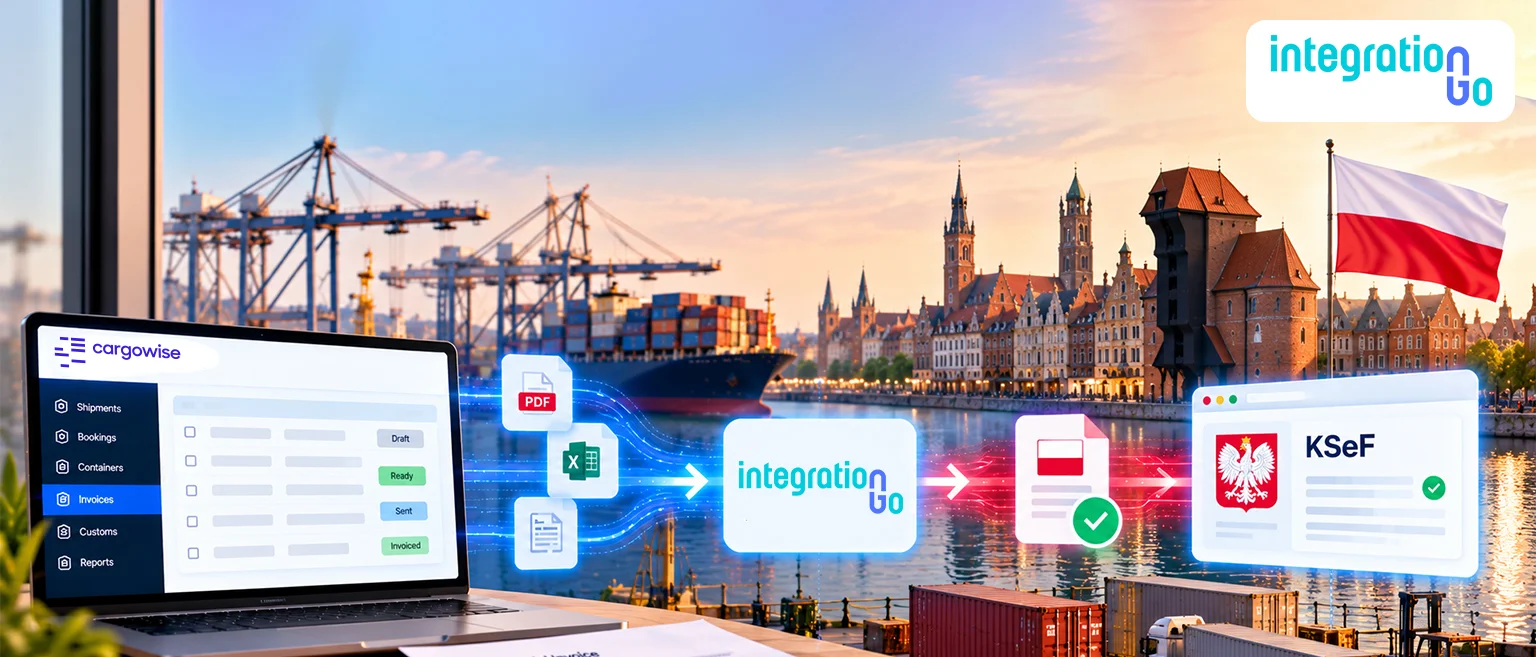
A typical integration workflow can include these stages.
1. Prepare the invoice in CargoWise. Your finance team reviews the transaction and confirms that the invoice details are ready.
2. Validate the required information. Customer identifiers, company details, invoice numbers, dates, tax information, and other required fields are checked against the applicable rules.
3. Map the data to the required structure. The integration transforms the relevant invoice information into the format accepted by the KSeF interface.
4. Submit the invoice. The connected workflow sends the structured invoice to KSeF using the appropriate authentication and submission process.
5. Process the response. The workflow captures the response, updates the relevant status, and makes errors visible for investigation.
6. Retain the invoice record. Relevant identifiers, submission results, and supporting records are made available to the appropriate finance workflow.
The exact implementation depends on your CargoWise configuration, available interfaces, and business requirements.
For freight forwarders, the benefit of planning this workflow correctly is simple: fewer disjointed steps between preparing an invoice and verifying its submission outcome.
Are Your CargoWise Invoice Data and VAT Rules Ready for KSeF?
Even a well-connected system can produce problems if the underlying invoice data is inaccurate. Integration planning should therefore begin with the information that moves between CargoWise and KSeF.
Company and taxpayer details
Confirm that the relevant Polish taxpayer information and company or branch details are correctly maintained. Authentication and access permissions must also be configured for the intended legal entity and workflow.
Customer information
Review the customer data used to generate invoices. Missing or inconsistent identifiers can create problems when invoice information is validated or prepared for submission.
VAT treatment and tax mapping
Freight invoices can contain different charges and tax treatments. The integration must preserve the correct tax information and map it to the required fields rather than simply transferring values from one system to another.
Invoice numbering and dates
Invoice references and date fields should follow the applicable rules. Where CargoWise and the external e-invoicing workflow use different numbering or date conventions, the mapping needs to account for those differences.
Structured invoice requirements
KSeF uses a defined structured invoice format. The integration must prepare the data according to the applicable schema rather than assuming that an ordinary PDF invoice is sufficient for submission.
These checks are important because successful data transfer does not necessarily mean that the invoice has passed every validation or processing stage.
For CargoWise users, the goal is to identify data problems as early as possible, before they create delays in the finance workflow.
How can You Confirm that KSeF has Accepted Your CargoWise Invoice?
Sending an invoice is only one part of the process. Your finance team also needs to know what happened after submission.
Imagine that a customer invoice has been prepared in CargoWise and sent through the connected workflow. If the submission fails, the team needs to know whether the problem relates to the invoice data, authentication, communication with the external system, or another processing issue.
Without clear status tracking, employees may have to check separate systems, search through logs, or contact colleagues to establish what happened.
A well-designed CargoWise integration should make the outcome easier to understand.
- Submission tracking: Identify which invoices have been sent and which are still waiting for processing.
- Response handling: Capture the response returned by KSeF and distinguish successful processing from failures or pending results.
- Error visibility: Make relevant error information available so the team can investigate and correct the underlying issue.
- Confirmation records: Retain the KSeF invoice identifier and the relevant official receipt or confirmation when returned.
- Exception follow-up: Help the team identify invoices that need attention instead of leaving them unnoticed in a queue.
KSeF supports invoice processing and the retrieval of official confirmation records, including the UPO (Urzędowe Poświadczenie Odbioru). The precise status and confirmation details depend on the response returned by the system.
For your finance team, this visibility helps answer three important questions: Was the invoice submitted? What response did KSeF return? Does the invoice need further action?
That is more useful than simply knowing that a file was sent.
Bring KSeF Supplier Invoices Into Your CargoWise Accounts Payable Workflow
Outgoing invoices are only one side of e-invoicing. Freight forwarders also need to manage supplier invoices received through KSeF.
These invoices may relate to transport providers, handling charges, operational services, or other shipment expenses. The challenge is making sure the information reaches the right accounts payable process and can be reviewed by the finance team.
A connected workflow can help by supporting the following processes.
Invoice retrieval and data transfer: Bring relevant supplier invoice information into the designated processing workflow, subject to the available integration capabilities and permissions.
Job and transaction matching: Help associate supplier invoice details with the appropriate CargoWise job or transaction where the required reference data is available.
Review and approval: Route invoices through the business’s existing allocation, reconciliation, and approval processes.
Exception handling: Flag missing references, mismatched values, or incomplete data for review rather than allowing unresolved issues to pass through unnoticed.
Record retention: Keep the relevant invoice details and supporting records accessible for finance operations and future reference.
The important distinction is that receiving an invoice electronically does not automatically complete accounts payable processing. The invoice may still require allocation, reconciliation, approval, and posting.
By planning the integration around the full workflow, businesses can reduce unnecessary rekeying and help finance teams spend less time moving information between systems.
Where can CargoWise–KSeF Integration Problems Start?
Many integration problems begin before an invoice reaches the external system. Incorrect source data, inconsistent mappings, missing permissions, or unclear error-handling procedures can interrupt the process.
Here are four areas worth reviewing before implementing or updating a KSeF workflow.
1. Incorrect source data
If customer identifiers, tax information, or invoice dates are wrong in the source record, transferring the information will not fix the problem. Validation should identify relevant issues early.
2. Incomplete field mapping
CargoWise and KSeF may handle certain fields differently. Each required field needs a clear mapping rule, including how missing or invalid values are handled.
3. Limited visibility into failures
If errors are recorded but not surfaced to the people responsible for resolving them, invoices can remain unprocessed longer than necessary.
4. Unclear retry procedures
A failed submission needs a defined response. Teams should understand what must be corrected, when a retry is appropriate, and how to avoid duplicate processing.
A practical implementation should also include testing, exception scenarios, access controls, and a clear process for monitoring the integration after it goes live.
These steps help make the workflow more reliable without assuming that every error can be prevented.
How IntegrationGo Helps Connect CargoWise Workflows With E-Invoicing Requirements?
Connecting CargoWise to an external e-invoicing system requires more than transferring invoice data. The integration needs to account for the information available in CargoWise, the target system’s requirements, and the actions your finance team must take when processing does not go as expected.
IntegrationGo works with CargoWise users on integration requirements and workflow design, helping identify how systems need to exchange information and where data mapping, validation, and error handling are needed.
For a Poland KSeF project, the approach can begin with understanding your current invoice workflow.
- Which invoice data needs to move from CargoWise?
- Which fields and tax details require validation or transformation?
- How should submission responses and exceptions be handled?
- Where should invoice references and confirmation records be made available?
- What should happen when an invoice cannot be processed successfully?
The answers help define the integration requirements before development begins. They also help ensure that the proposed workflow fits the way your finance team actually works.
The final implementation depends on the available CargoWise interfaces, KSeF technical requirements, and the agreed project scope. KSeF access, authentication, and tax compliance obligations must be addressed as part of the solution rather than assumed to be provided automatically by an integration.
For freight forwarders, this means planning the connection around real operational needs: accurate invoice data, clear processing outcomes, and fewer unnecessary manual steps.
Prepare Your CargoWise Workflow for Poland’s KSeF Requirements
Poland’s KSeF requirements affect how businesses issue and receive invoices. For freight forwarders using CargoWise, preparing for these requirements means reviewing more than invoice transmission. Data quality, tax mapping, submission tracking, supplier invoice processing, and exception handling all matter.
A properly scoped integration can help connect these steps and give finance teams better visibility into their invoice workflows.
Planning a CargoWise integration for Poland’s KSeF requirements? Contact us about your current workflow, data exchange needs, and integration options.
With the right approach to End-to-End CargoWise integration, your team can plan a workflow that connects operational and financial processes while keeping validation, monitoring, and exception handling in view.