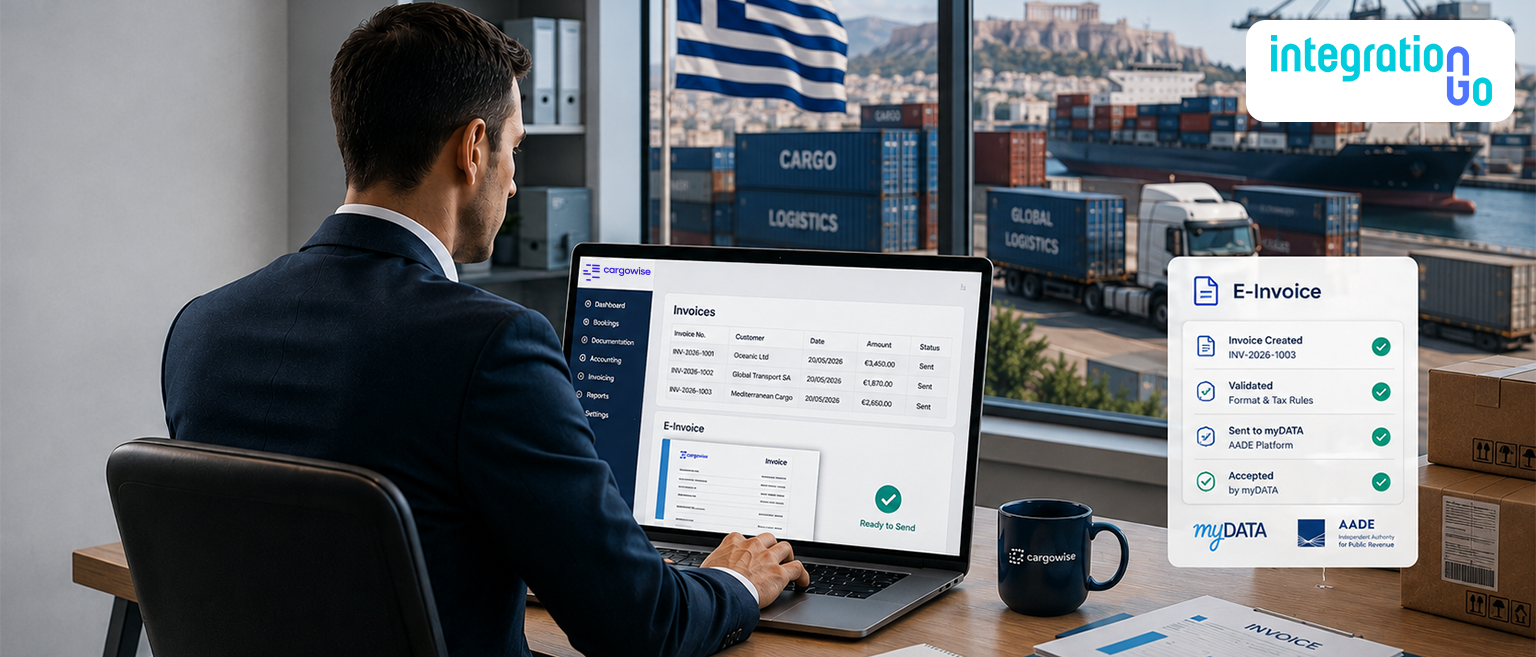

For logistics businesses using CargoWise, Greece’s e-invoicing mandate is more than a change in how invoices look. It affects how invoice data is created, prepared, transmitted, and reported electronically.
For businesses covered by Greece’s second implementation period, mandatory e-invoicing begins October 1, 2026, with a gradual transition available through December 31, 2026 under specific conditions.
For CargoWise users, the practical question is straightforward: How can existing CargoWise billing data connect with Greece’s e-invoicing process without creating another manual workflow?
That is where IntegrationGo acts as the middleware, helping connect the CargoWise billing environment with the required electronic invoicing process.
What is Greece’s 2026 E-Invoicing Mandate?
Greece is introducing mandatory electronic invoicing in phases. The first period applies to businesses with gross revenue exceeding €1 million based on their 2023 tax return, while the remaining businesses fall under the second period beginning October 1, 2026.
Under the new process, businesses need to issue and transmit invoices through compliant electronic channels. The information is also transmitted to Greece’s myDATA platform as part of the electronic reporting process. AADE provides several transmission routes, including electronic invoicing providers and other supported channels.
For a logistics business, this means invoices generated from freight, transportation, warehousing, customs, and other services need to fit into an electronic invoicing workflow rather than relying only on traditional invoice delivery.
Why does the Mandate Matter for Logistics Businesses Using CargoWise?
A logistics invoice rarely contains just a customer name and total amount. It can bring together freight charges, handling fees, transportation services, taxes, customer information, currency, and shipment-related references.
Much of that information is already created and managed within CargoWise.
Without a connected process, teams may need to move invoice information manually, check the same data in multiple places, or fix errors before an invoice can be transmitted. As invoice volumes grow, that can become a real operational headache.
A CargoWise e-invoicing integration connects the billing information already created in CargoWise with the electronic invoicing workflow. Instead of rebuilding invoices somewhere else, businesses can keep their existing logistics and billing processes connected.
How could Greece’s E-Invoicing Requirements Change Your CargoWise Workflow?
The biggest change is that creating an invoice in CargoWise is no longer the end of the process.
The information behind the invoice needs to be prepared for electronic transmission and reporting. Customer details, VAT information, invoice numbers, charges, taxes, currency, and other relevant information need to be available and correctly mapped.
The workflow can therefore move from the following:
Invoice Created → Invoice Sent
to:
Invoice Created in CargoWise → Data Validated → E-Invoice Prepared → Transmitted → Response Handled
For logistics teams, this creates a more connected billing process. Instead of manually transferring invoice information after an invoice is created, the integration can move the required data through the next steps automatically.
Which CargoWise Invoice Data Needs to be Ready?
Before setting up the integration, businesses should review the information CargoWise uses to create their invoices. Depending on the transaction, this may include customer and business details, VAT and tax information, invoice number and date, service and charge details, tax amounts, currency, payment information, and relevant references.
The key isn't simply having the information somewhere in CargoWise. It needs to be accurate, complete, and mapped to the appropriate electronic invoice fields.
That's why data mapping is an important part of the preparation. If a required value is stored in CargoWise but does not map to the correct field in the electronic invoice structure, the integration needs to know how to handle that information.
Good source data makes the entire integration easier to manage and reduces avoidable invoice errors.
How does CargoWise Invoice Data Move through Greece’s E-Invoicing Process?
Once the data is ready, the workflow can be kept fairly simple:
Invoice Created in CargoWise
↓
Data Validation
↓
IntegrationGo Middleware
↓
Data Mapping & Transformation
↓
Electronic Invoice Transmission
↓
myDATA Reporting / Response
↓
Status & Exception Handling
CargoWise remains the source of the relevant logistics and billing information.
IntegrationGo acts as the middleware layer, helping validate the information, map CargoWise fields, transform data where required, and manage the connection with the electronic invoicing workflow.
AADE states that businesses using an electronic invoicing provider can have income documents transmitted automatically to myDATA in real time after issuance.
This means the business can build the electronic process around its existing CargoWise workflow instead of creating a separate manual invoicing routine.
How does IntegrationGo integrate CargoWise with Greece’s E-Invoicing Workflow?
IntegrationGo sits between CargoWise and the external Greek e-invoicing workflow.
The basic connection looks like:
CargoWise → IntegrationGo → E-Invoicing Process → myDATA
The integrationGo middleware can support the key steps needed to move invoice information between these environments:
- Validation of relevant invoice data
- Mapping CargoWise fields to the required structure
- Transformation of data where needed
- Transmission through the applicable electronic workflow
- Response handling for successful or unsuccessful transactions
The purpose is not to replace CargoWise. It is to connect the billing workflow businesses already use with the electronic invoicing process they need to support.
For logistics teams, that can mean less duplicate entry and a clearer path from invoice creation to electronic transmission.
What Happens When an E-Invoice Fails or Needs Correction?
Not every invoice will move through the process perfectly the first time. Missing information, incorrect tax details, or validation issues can require an invoice to be reviewed and corrected.
A connected process can make that easier to manage:
Invoice Created → Validation → Issue Identified → Correction → Reprocessing
Instead of manually checking every transaction, finance teams can focus on the invoices that actually need attention.
This becomes particularly important for logistics businesses handling large invoice volumes, where even a small number of exceptions can create significant additional work.
The goal is not just to automate successful invoices. It is to create a workflow where exceptions are visible, manageable, and easier to resolve.
What should Logistics Businesses have Ready Before October 2026?
Before the mandate begins for businesses in the second implementation period, logistics teams should focus on getting the complete workflow ready.
That means reviewing CargoWise invoice data, identifying missing information, defining field mappings, selecting the appropriate electronic invoicing route, configuring the IntegrationGo middleware, and testing real invoice scenarios.
Testing should include more than a standard invoice. Businesses should also test corrections, validation failures, and response handling so teams know what happens when something doesn't go according to plan.
AADE confirms that the second implementation period begins October 1, 2026, with gradual fulfillment permitted through December 31, 2026, under specified conditions.
Preparing before the deadline gives businesses time to resolve data and workflow issues without putting day-to-day billing operations under unnecessary pressure.
Conclusion
Greece’s e-invoicing mandate makes the connection between CargoWise billing data and electronic invoicing increasingly important for logistics businesses.
With IntegrationGo as the middleware, businesses can build an end-to-end CargoWise integration connecting invoice creation, data validation, mapping, electronic transmission, and response handling.
Ready to prepare CargoWise for Greece’s 2026 e-invoicing mandate? Contact us to discuss an End-to-end CargoWise integration built around your logistics workflow.