
Walk into any busy warehouse, and everything looks organized, racks are labeled, goods are moving, and teams are working. But behind that activity, there’s often a different story. Inventory numbers don’t always match. Orders get delayed. Teams double-check stock because they’re not fully confident in the system.
The issue isn’t always the warehouse itself, it’s how systems communicate.
CargoWise WMS manages warehouse operations in real time, while ERP systems handle financials, planning, and broader business processes. But when these two don’t talk to each other, gaps appear.
That’s where integration changes everything, bringing warehouse operations and business systems into one continuous flow.
What is CargoWise WMS and How does it Transform Warehouse Operations?
CargoWise WMS is more than a traditional warehouse system, it is a warehouse execution engine built within a cloud-based logistics platform that manages how inventory moves and how orders are fulfilled in real time.
Instead of simply recording stock levels, it actively controls warehouse workflows and ensures that every movement is tracked accurately from receiving to dispatch.
It enables businesses to:
- Gain real-time visibility into inventory across locations and bins
- Manage picking, packing, and shipping workflows efficiently
- Track stock movement with precision at every stage
- Optimize storage space and improve warehouse layout
What makes CargoWise WMS particularly effective is its ability to connect warehouse operations with the broader logistics ecosystem, including transportation, customs, and financial processes.
This means that warehouse activity is no longer isolated, it becomes part of a continuous supply chain workflow, improving both speed and accuracy.
Which ERP Systems Integrate Best with CargoWise WMS for Warehouse Alignment?
ERP systems are designed to manage the business side of operations, including financials, procurement, and reporting. However, most ERP platforms do not handle real-time warehouse execution, which is why they rely on systems like CargoWise WMS.
Some of the most commonly integrated ERP systems include:
- Microsoft Dynamics 365 – Known for financial management and planning capabilities
- SAP Business One / SAP S/4HANA (without EWM enabled) – Strong enterprise-level ERP systems
- Oracle NetSuite – A cloud ERP widely used for financial and operational management
- Epicor – Suitable for mid-sized businesses with growing operations
- Xero-based ERP environments – Focused on financial tracking with external operational support
- QuickBooks Enterprise with extensions – Common among growing logistics companies
These systems manage planning and financial visibility, while CargoWise WMS handles warehouse execution. When integrated, they create a unified environment where operational activity and financial data remain aligned.
Why do Warehouse Operations Struggle Without System Integration?
When warehouse systems and ERP operate independently, teams are forced to act as the connection between them. This leads to delays, inconsistencies, and unnecessary manual effort.
Inventory updates may not reflect immediately in ERP, leading to discrepancies. Orders created in ERP may not reach the warehouse system in time, slowing down fulfillment. Teams often rely on spreadsheets or manual processes to bridge the gap.
Over time, this results in:
- Inventory mismatches across systems
- Delays in processing and fulfilling orders
- Increased manual data entry and corrections
- Limited real-time visibility into operations
- Higher risk of errors and inefficiencies
As operations grow, these challenges become more difficult to manage and begin to impact overall performance.
What Changes When CargoWise WMS and ERP Systems Work Together?
When CargoWise WMS and ERP systems are integrated, workflows become continuous rather than fragmented.
Inventory movements in the warehouse are reflected instantly in ERP, ensuring that both systems share the same data. Orders created in ERP flow directly into warehouse execution without delay. Every update, whether it’s stock movement or order status, is visible across the organization in real time.
This creates a connected environment where:
- Data remains consistent across systems
- Orders move smoothly from planning to execution
- Teams work with real-time information
- Decision-making becomes faster and more accurate
Instead of reacting to discrepancies, teams operate with confidence and clarity, improving both efficiency and collaboration.
How Integration Improves Warehouse Efficiency Across Daily Operations?
Warehouse efficiency is not just about speed, it’s about removing friction from everyday processes.
When systems are integrated, data flows automatically between ERP and WMS, eliminating the need for manual updates. Orders are processed faster because they move directly into warehouse workflows. Warehouse teams receive accurate information, reducing the need for verification.
This leads to smoother operations where:
- Order processing becomes faster and more consistent
- Picking and packing errors are significantly reduced
- Teams spend less time correcting data and more time executing tasks
- Warehouse resources are used more effectively
Over time, these improvements create a more productive and reliable warehouse environment.
How Integrated Systems Strengthen Inventory Accuracy and Control?
Inventory accuracy is critical for both operational efficiency and financial reporting. Without integration, discrepancies between systems can lead to stock shortages, overstocking, and incorrect reporting.
Integration ensures that inventory data remains synchronized across systems. Every movement, receiving, transferring, or shipping, is captured and updated in real time.
This provides:
- Consistent inventory levels across WMS and ERP
- Improved visibility into stock availability
- Accurate inventory valuation for financial reporting
- Better demand planning and forecasting
With accurate data, businesses can make more informed decisions and maintain better control over inventory.
How Faster Order Fulfillment Becomes Possible with Connected Systems?
Order fulfillment is where warehouse performance directly impacts customer satisfaction.
When systems are disconnected, delays occur because orders need to be manually transferred and verified. Integration removes these delays by ensuring that orders flow directly into warehouse execution.
Warehouse teams receive complete and accurate information, allowing them to process orders immediately.
This results in:
- Faster order processing and dispatch
- Reduced shipment errors
- Improved customer communication
- Higher service reliability
Customers benefit from faster delivery and more accurate orders, which strengthens trust and satisfaction.
Why is Integration Essential for Scaling Warehouse Operations Smoothly?
As warehouse operations grow, managing increased volume becomes more complex. More inventory, more orders, and more transactions increase the risk of errors and inefficiencies.
Integration allows businesses to scale without increasing manual effort. Systems handle data flow automatically, ensuring that processes remain consistent.
With integration, businesses can:
- Manage higher volumes without operational delays
- Maintain consistent workflows across multiple locations
- Reduce errors as complexity increases
- Ensure real-time visibility at scale
This makes it possible to grow warehouse operations while maintaining control and efficiency.
What Businesses should Know Before Integrating CargoWise WMS with ERP?
Before implementing integration, businesses need to ensure that their systems and workflows are aligned.
Integration requires:
- Clear understanding of how data should flow between systems
- Accurate and consistent data before integration begins
- Alignment between warehouse workflows and ERP processes
- A scalable approach that supports future growth
Planning these elements carefully ensures that integration delivers long-term value.
How IntegrationGo Connects CargoWise WMS with ERP for Smooth Data Flow?
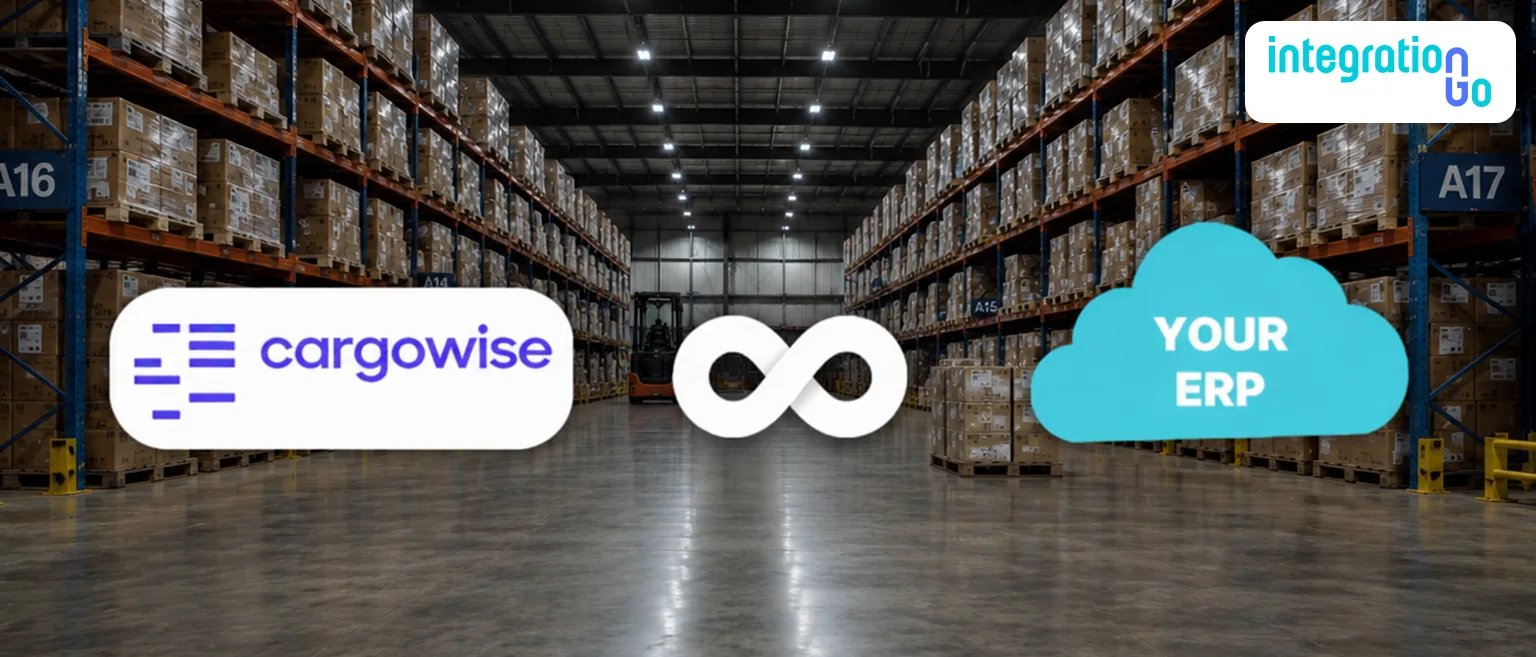
IntegrationGo acts as the intermediary layer that connects CargoWise WMS with ERP systems, ensuring that data flows in a structured and reliable way across warehouse and business processes.
Rather than relying on direct system-to-system communication, IntegrationGo manages the flow based on real operational logic.
The integration process typically includes:
- Data extraction from ERP systems
Orders, inventory data, and financial details are captured from ERP platforms - Data mapping and transformation
Information is structured to align with CargoWise WMS formats and workflows - Automated warehouse execution triggers
Orders are pushed into CargoWise WMS for picking, packing, and dispatch - Real-time inventory synchronization
Inventory movements in the warehouse are reflected back in ERP instantly - Validation and error control
Data is checked to ensure accuracy before processing - Continuous monitoring and optimization
Integration adapts as business operations grow and evolve
This ensures that warehouse execution and ERP planning operate as one continuous workflow rather than two disconnected systems.
Conclusion
Integrating CargoWise WMS with ERP systems transforms warehouse operations into a connected, real-time workflow where data, processes, and teams move together smoothly. It improves efficiency, strengthens inventory control, and provides complete visibility across operations.
With the right approach, businesses can achieve true end-to-end integration, ensuring that warehouse execution and business systems operate as one. Contact us today to build a fully connected warehouse ecosystem and unlock the full potential of your operations.