
Every freight forwarder knows the pressure, quotes need to go out quickly, shipments must be booked on time, and updates can’t afford to lag. From the outside, everything seems connected, but behind the scenes, there’s often a disconnect.
Customer details sit in one system, while shipments are handled in another. Teams end up filling the gaps manually, copying, checking, and fixing data just to keep things moving. That’s where time gets lost.
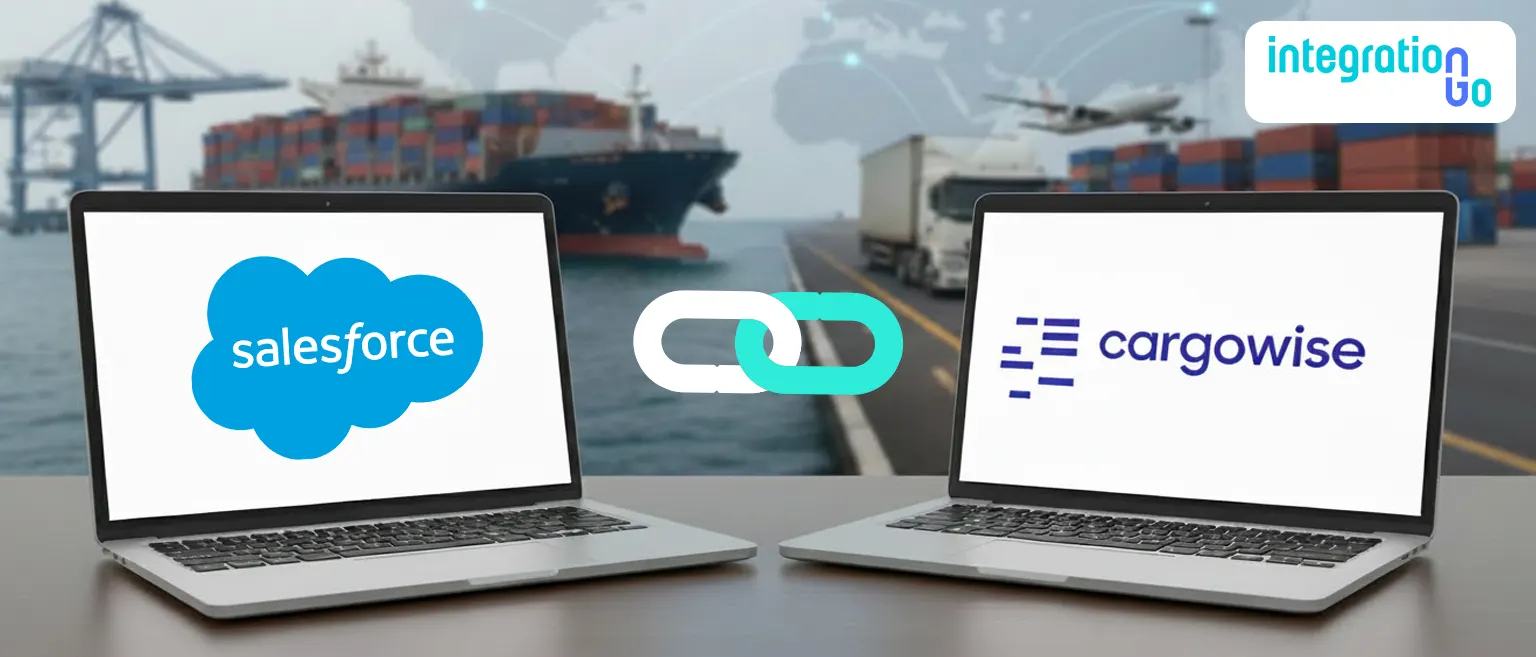
Today, freight isn’t just about moving cargo, it’s about keeping information moving just as smoothly. That’s why bringing Salesforce and CargoWise together matters, creating a true end-to-end CargoWise integration where everything flows as one.
What is Salesforce and How does it Shape Customer and Revenue Workflows?
Salesforce is more than a CRM, it’s the starting point of every revenue-generating activity in a freight business. It captures the entire customer journey, from the first interaction to deal closure and beyond.
In freight forwarding, Salesforce typically handles:
- Customer onboarding and relationship management
- Quote generation and pricing negotiations
- Sales pipeline tracking and deal forecasting
- Customer communication and service visibility
What makes Salesforce powerful is its ability to organize and centralize customer intelligence. Sales teams can track every interaction, understand customer needs, and manage opportunities with clarity.
But when you look deeper, Salesforce operates on intent and commitment, it tells you what the customer wants and what has been promised. It does not execute shipments, manage logistics workflows, or handle operational complexity.
That’s where the gap begins to appear.
What is CargoWise and Why does it Act as the Operational Backbone?
CargoWise is a cloud-based ERP and logistics execution platform designed specifically for freight forwarders and 3PL providers. It serves as the operational backbone of the business, managing everything from shipment creation to financial processing.
Unlike generic ERP systems, CargoWise is built for logistics complexity. It connects operational workflows, documentation, compliance, and financial processes into one platform.
CargoWise handles:
- Shipment planning, booking, and consolidation
- Documentation such as HBL, MBL, and commercial invoices
- Customs compliance and regulatory workflows
- Warehouse and transport operations
- Financial processes, including accruals, invoicing, and cost tracking
What makes CargoWise unique is that it doesn’t just manage data, it manages execution. It reflects what is actually happening on the ground, from cargo movement to cost allocation.
But here’s the key insight: CargoWise works best when it receives structured, accurate data from upstream systems like Salesforce.
What Happens When Salesforce and CargoWise are Disconnected?
When these systems operate separately, teams become responsible for connecting them manually. This creates delays, inconsistencies, and unnecessary effort.
Sales teams may close deals quickly, but operations still need to re-enter data. Quotes may not match shipment execution, and updates take time to flow across teams.
Over time, this leads to:
- Duplicate data across systems
- Misaligned pricing and shipment details
- Delayed communication between departments
- Increased manual workload
- Limited real-time visibility
These issues may seem manageable at first, but they grow rapidly as operations scale.
What Changes When Salesforce and CargoWise Work as One Connected System?
When Salesforce and CargoWise operate as one connected system, the entire workflow shifts from fragmented to seamless.
Customer data no longer needs to be re-entered. Quotes created in Salesforce move directly into operational execution. Shipment updates from CargoWise flow back into Salesforce, giving sales and customer service teams real-time visibility.
But beyond automation, the real transformation happens in how teams operate.
Sales teams no longer work in isolation, they understand operational realities. Operations teams no longer rely on assumptions, they work with accurate, structured data. Customer service teams respond faster because they have real-time shipment insights.
This creates a connected environment where:
- Every deal transitions smoothly into execution
- Every shipment reflects the original customer promise
- Every team works with the same, consistent data
Instead of reacting to gaps, teams operate proactively. Decisions become faster, communication becomes clearer, and workflows become more predictable.
What Role does Integration Play in Managing Customer, Quote, and Shipment Alignment?
Integration plays a critical role in ensuring that customer, quote, and shipment workflows stay aligned from start to finish.
When systems are connected, data is created once and flows consistently across every stage of the process. Customer records remain unified, quotes reflect accurate pricing, and shipment execution aligns with what was agreed.
This alignment strengthens the entire workflow by improving both accuracy and visibility.
It allows teams to:
- Maintain consistent customer data across systems
- Convert quotes into shipments without discrepancies
- Track shipment status in real time without switching systems
- Improve communication between sales, operations, and service teams
- Reduce manual corrections caused by mismatched data
More importantly, integration reduces the friction between planning and execution. Instead of fixing errors or chasing updates, teams focus on delivering shipments efficiently and meeting customer expectations.
What Benefits do Freight Forwarders Experience After Integration?
Once Salesforce and CargoWise are connected, improvements become visible across all departments.
Operations become faster because data flows automatically. Accuracy improves because systems share the same information. Teams spend less time on manual tasks and more time on strategic work.
Businesses begin to experience:
- Faster quote-to-shipment conversion
- Reduced manual data entry and duplication
- Improved data accuracy across systems
- Real-time visibility into operations
- Better coordination between teams
These improvements directly impact both operational efficiency and customer satisfaction.
What Role does Integration Play in Scaling Freight Operations?
As freight operations grow, complexity increases. More shipments mean more data, more coordination, and more opportunities for errors.
Integration allows businesses to scale without adding manual effort. Systems handle data flow automatically, ensuring consistency even as volume increases.
With integration, companies can:
- Manage higher shipment volumes efficiently
- Maintain consistent workflows across locations
- Reduce errors as complexity grows
- Ensure real-time visibility at scale
This allows freight forwarders to grow without losing control over operations.
How does IntegrationGo Enable Smooth Salesforce and CargoWise Workflows?
IntegrationGo acts as the intermediary layer that connects Salesforce and CargoWise in a structured and scalable way, ensuring that data flows smooth across systems.
Rather than relying on direct system connections, IntegrationGo manages the flow of information based on how freight workflows actually operate. It ensures that customer data, quotes, and shipment details move consistently between systems without manual intervention.
The process follows a logical workflow:
Customer and Opportunity Capture
Customer data is created in Salesforce and becomes the foundation for all downstream processes.
Quote Structuring and Mapping
Quotes are mapped to align with CargoWise formats, ensuring pricing consistency across systems.
Shipment Creation Automation
Once a deal is confirmed, shipment details are automatically transferred into CargoWise.
Real-Time Status Synchronization
Shipment updates flow back into Salesforce through the API, keeping sales and customer service teams informed in real time.
Data Validation and Accuracy Control
Validation rules ensure that incorrect or incomplete data is identified early.
Continuous Monitoring and Scaling
The integration adapts as operations grow, ensuring long-term performance and reliability.
Through this approach, IntegrationGo ensures that Salesforce and CargoWise operate as one unified workflow, improving both efficiency and visibility.
Conclusion
Salesforce and CargoWise integration transforms disconnected workflows into a unified system where customer, quote, and shipment processes move together in real time.
With the right intermediary layer, businesses achieve true end-to-end integration, improving visibility, reducing manual effort, and enabling scalable growth.
Contact us today to build a fully connected, end-to-end freight workflow and eliminate gaps between your systems.