
Most finance teams don’t struggle because they lack tools. They struggle because those tools don’t work together.
Invoices are generated in one system. Payments are tracked in another. Financial reports are built separately. And somewhere in between, teams spend hours reconciling numbers that should have aligned from the start.
At first, it feels manageable. The process works, just with a bit of extra effort. But as transaction volumes grow, those small inefficiencies begin to compound. Delays increase, visibility decreases, and decision-making slows down.
The real challenge isn’t managing A/R, it’s managing disconnected systems that prevent data from flowing freely.
📊 The Role of Accounting Software in Modern A/R Operations
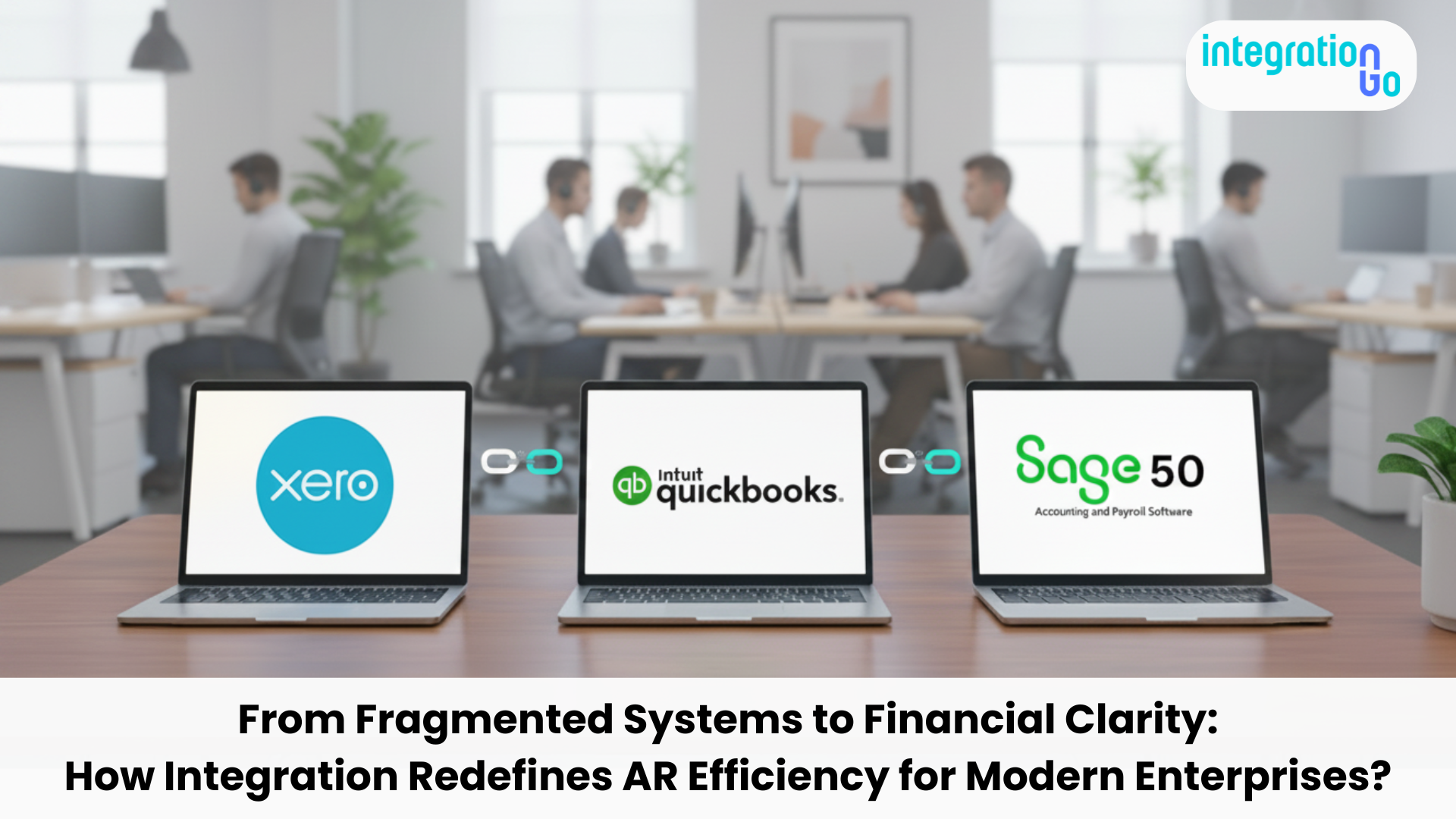
Accounting platforms sit at the core of financial operations. Solutions like Xero, QuickBooks, Sage 50, and enterprise-level systems such as Oracle NetSuite are designed to handle invoicing, payments, and reporting efficiently.
Individually, these systems perform well. They provide structure, accuracy, and control over financial data. However, when they operate without integration with operational workflows, they become dependent on manual inputs to stay updated.
In many organizations, accounting systems act as endpoints rather than real-time engines. Data arrives late, often after being processed and reprocessed across multiple steps.
This creates challenges such as:
• Manual transfer of invoice and transaction data between systems
• Delays in reflecting payments and outstanding balances
• Limited visibility into real-time financial performance
• Increased workload during reconciliation and reporting cycles
Instead of enabling automation, finance teams often spend their time maintaining data consistency across systems.
🔍 Where Fragmentation Disrupts A/R Efficiency?
Disconnected systems don’t create one major failure, they create continuous friction.
Operational data may update instantly, but financial data lags behind. Invoice status may not reflect real-time payment activity. Finance teams often rely on exports, spreadsheets, and manual validation processes to ensure accuracy.
As this continues, several issues begin to surface:
• Reconciliation becomes an ongoing task rather than a controlled process
• Mismatches between operational and financial records increase
• Teams rely heavily on manual verification to ensure accuracy
• Confidence in financial reporting begins to decline
The more systems involved, the more complex it becomes to maintain consistency. Over time, this affects not just finance teams but also the entire organization’s ability to rely on data.
⏳ The Impact on Cash Flow and Business Performance
A/R inefficiencies directly influence how quickly revenue moves through the business.
When invoices are delayed, cash inflow slows. When payment updates are not reflected in real time, forecasting becomes less reliable. When reconciliation takes longer, reporting cycles extend.
This creates a ripple effect across the organization:
• Slower invoice-to-cash cycles impact working capital
• Delayed revenue recognition affects financial planning
• Reduced forecasting accuracy limits strategic decision-making
• Extended month-end close timelines delay performance reviews
Even small inefficiencies can scale rapidly in high-volume environments, making it harder to maintain financial control.
⚙️ How Integration Transforms A/R Workflows?
Integration removes the need for manual data movement and allows systems to operate as a unified workflow.
Instead of exporting and re-entering data, information flows automatically between platforms. Invoice data, payment updates, and financial records remain aligned in real time.
This creates a more efficient operational environment where:
• Invoice generation and posting happen without delays
• Payment data updates instantly across systems
• Reconciliation becomes faster and more accurate
• Financial reports reflect real-time business activity
With integration in place, finance teams shift from correcting data to analyzing trends, improving margins, and supporting business decisions.
📈 What Financial Clarity Looks Like After Integration?
When systems are connected, A/R becomes more structured, predictable, and transparent.
Organizations begin to see:
• Faster billing cycles and improved invoice turnaround time
• Reduced reconciliation effort and fewer manual errors
• Real-time visibility into receivables and cash flow
• Shorter and more controlled financial closing cycles
This clarity allows businesses to operate with confidence, respond quickly to changes, and make informed decisions without delay.
🧠 Why A/R is Now a Strategic Function?
A/R is no longer just a back-office activity. It has become a key driver of business performance.
When systems are aligned, A/R contributes directly to:
• Stronger cash flow management
• Improved customer experience through accurate billing
• Faster, data-driven decision-making
• Better alignment between operations and finance teams
Instead of being a reactive process, A/R becomes a proactive function that supports growth and efficiency.
If reconciliation still dominates your A/R workflow, it may not be a process issue, it’s likely a system connectivity issue.
🚀 Final Thought
Fragmented systems don’t stop your operations, they slow them down in ways that are easy to overlook but difficult to ignore over time.
As businesses scale, the need for connected financial workflows becomes more critical. Integration brings structure, speed, and clarity to A/R processes, allowing organizations to operate more efficiently and make better decisions.
Ready to move from fragmented systems to financial clarity? Explore end-to-end logistics integration and build a fully connected A/R workflow.