
Your team has a shipment ready to move. The shipping line needs booking details, the transport provider is waiting for pickup instructions, the warehouse needs cargo information, and the overseas agent is asking for shipping documents.
Meanwhile, your operations team is checking emails, logging into supplier portals, and updating shipment information in CargoWise.
Now imagine handling 50 or 100 shipments with different suppliers every day. Keeping track of every booking, confirmation, document, and status update becomes a serious coordination challenge.
The problem isn't the number of suppliers you work with. It's the amount of manual effort required to manage information coming from different systems.
Let's look at where these challenges arise and how CargoWise Supplier Integration can help.
What Challenges do Freight Forwarders Face When Managing Multiple Suppliers?
Freight forwarders depend on several logistics partners to move shipments from origin to destination. A single shipment may involve a shipping line, trucking company, warehouse, customs broker, and overseas agent.
Each supplier has its own way of handling bookings, sharing documents, and providing updates.
For example, your team might receive a shipping line booking confirmation through a portal, a transport schedule through email, and warehouse cargo availability through a separate system.
The challenge starts when all this information needs to be brought together and updated in CargoWise.
Some common problems include:
- Delayed booking confirmations: Your team waits for suppliers to confirm space, pickup schedules, or service availability.
- Scattered shipment information: Booking details, documents, and status updates are spread across different platforms.
- Missing shipment references: Supplier updates may arrive without the correct job number, booking reference, or container details.
- Document discrepancies: Incorrect consignee details, cargo descriptions, or shipment references require additional checks.
- Unexpected supplier charges: Additional handling, transportation, or storage charges can affect the original shipment cost.
When these issues happen across multiple shipments, your operations team spends more time coordinating with suppliers and correcting information than managing the actual movement of cargo.
Why does Your Team have to Switch Between Different Supplier Systems to Manage Shipments?
Here's a situation your operations team may recognize.
You've arranged an export shipment and booked space with a shipping line. Now you need to coordinate container pickup with a transport provider and cargo delivery to the warehouse.
Your team checks the shipping line portal for booking confirmation, emails the transport provider for pickup details, and contacts the warehouse to confirm cargo receipt.
Once the updates arrive, someone needs to review the information and enter the relevant details into CargoWise.
Now consider what happens when the transport provider changes the pickup schedule. Your team needs to locate the latest update, verify the container reference, inform the relevant people, and update the shipment record.
If one email gets missed or an outdated spreadsheet is used, different teams may end up working with different information.
This creates several operational issues:
- Repeatedly checking supplier portals for updates.
- Following up on unanswered emails.
- Entering the same shipment details into different systems.
- Correcting inconsistent booking and container references.
- Delays in sharing updated information with customers and internal teams.
The real issue is that your team becomes the communication link between every supplier system and CargoWise.
A structured integration can reduce this dependency by allowing supported supplier information to move directly into your operational system.
Which Supplier Activities can You Manage through CargoWise Integration?
Different suppliers handle different parts of a shipment, so the information you exchange depends on their services and available systems.
For example:
- Shipping lines: Booking requests, booking confirmations, vessel schedules, and shipment status updates.
- Transport providers: Pickup requests, container details, delivery instructions, and transport updates.
- Warehouses: Cargo receipts, inventory information, handling updates, and release details.
- Overseas agents: Shipment details, arrival updates, and supporting documents.
- Other logistics partners: Agreed operational information, references, and transaction details.
Consider a transport provider sending a container pickup confirmation. Instead of your team manually copying the details from an email into CargoWise, the integration can receive the information, map the relevant fields, and transfer it to the appropriate shipment record.
The exact information exchanged depends on the supplier's interface and the agreed integration requirements.
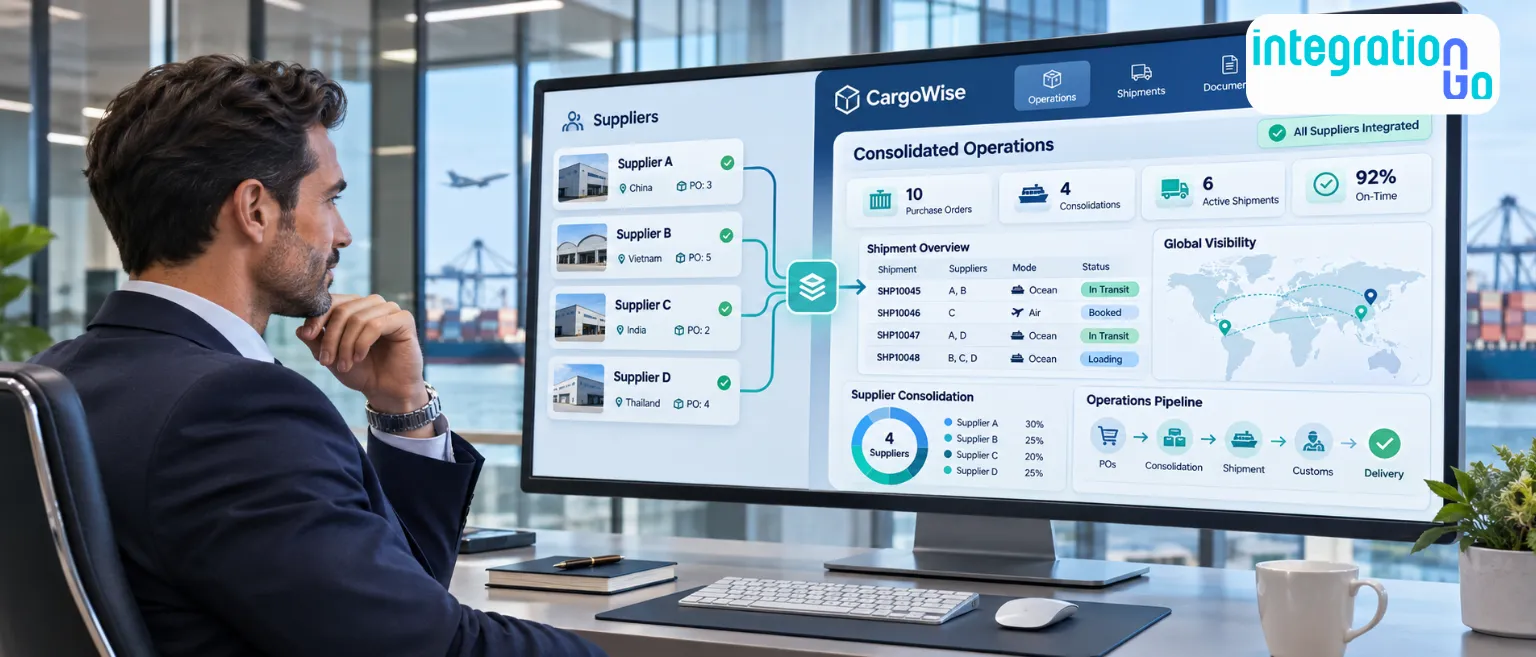
How does CargoWise Supplier Integration Bring Multiple Supplier Systems into One Platform?
This is where middleware makes a difference.
IntegrationGo acts as the middleware between supplier systems and CargoWise. It manages the information exchange, ensuring supplier data is processed and mapped before reaching the appropriate CargoWise records.
Here's how the workflow operates:
- Receive supplier information: Booking details, shipment updates, and documents are received through supported APIs, EDI, or other configured interfaces.
- Validate incoming data: Required fields, shipment references, and configured business rules are checked.
- Transform and map information: Supplier-specific formats are converted and mapped to the corresponding CargoWise fields.
- Transfer data to CargoWise: Processed information is sent to the relevant operational records through the configured interface.
- Handle exceptions: Missing references, incorrect information, or failed transfers are flagged for investigation where supported.
For example, when a shipping line sends a booking confirmation, IntegrationGo's middleware can process the message, map the booking reference and shipment details, and transfer the information into CargoWise.
This reduces the need for your team to manually handle every supplier update.
What Improvements can You Expect When Your Suppliers Work through One Connected Workflow?
Once supplier information starts moving through connected workflows, your operations team can spend less time switching between systems and more time coordinating shipments.
You'll have a better opportunity to:
- Reduce repeated data entry and manual follow-ups.
- Access relevant booking and shipment updates more easily.
- Maintain consistent shipment references.
- Improve coordination between suppliers and operations teams.
- Reduce delays caused by missing or overlooked information.
This is also an important part of supply chain integration. When shipping lines, transport providers, warehouses, and other logistics partners exchange information through connected systems, your team can manage shipment activities with better coordination.
The aim isn't simply to connect more systems. It's to make sure the right information reaches the right people at the right time.
How does IntegrationGo's Middleware Connect Your Supplier Systems with CargoWise?
Every freight forwarder works with different suppliers, and not every supplier uses the same technology.
At IntegrationGo, we start by understanding how your team communicates with suppliers and manages shipment information in CargoWise.
We then act as the middleware between your supplier systems and CargoWise, managing data exchange, validation, transformation, and field mapping.
We configure the appropriate integration methods based on supplier capabilities, including API/EDI communication where supported. We also test booking updates, shipment information, document exchanges, and exception scenarios to make sure the workflow meets your operational requirements.
Our focus is to bring your supplier information into a more organized workflow while reducing the manual coordination involved in everyday freight operations.
How can You Simplify Supplier Coordination with End-to-End CargoWise Integration?
Managing multiple suppliers shouldn't mean chasing updates across different platforms all day. With the right CargoWise supplier integration, you can bring relevant supplier information into one operational system and make shipment coordination easier for your team.
Contact us to discuss your supplier integration requirements and discover how CargoWise Integration can simplify your supplier coordination and freight operations.