
Freight operations move fast today, but many logistics companies still rely on disconnected systems behind the scenes. Transportation workflows often live in CargoWise, while financial planning, procurement, and reporting sit in ERP systems like Epicor.
As shipment volumes grow, these disconnected workflows create delays, manual reconciliation, duplicate data entry, and limited operational visibility across the supply chain.
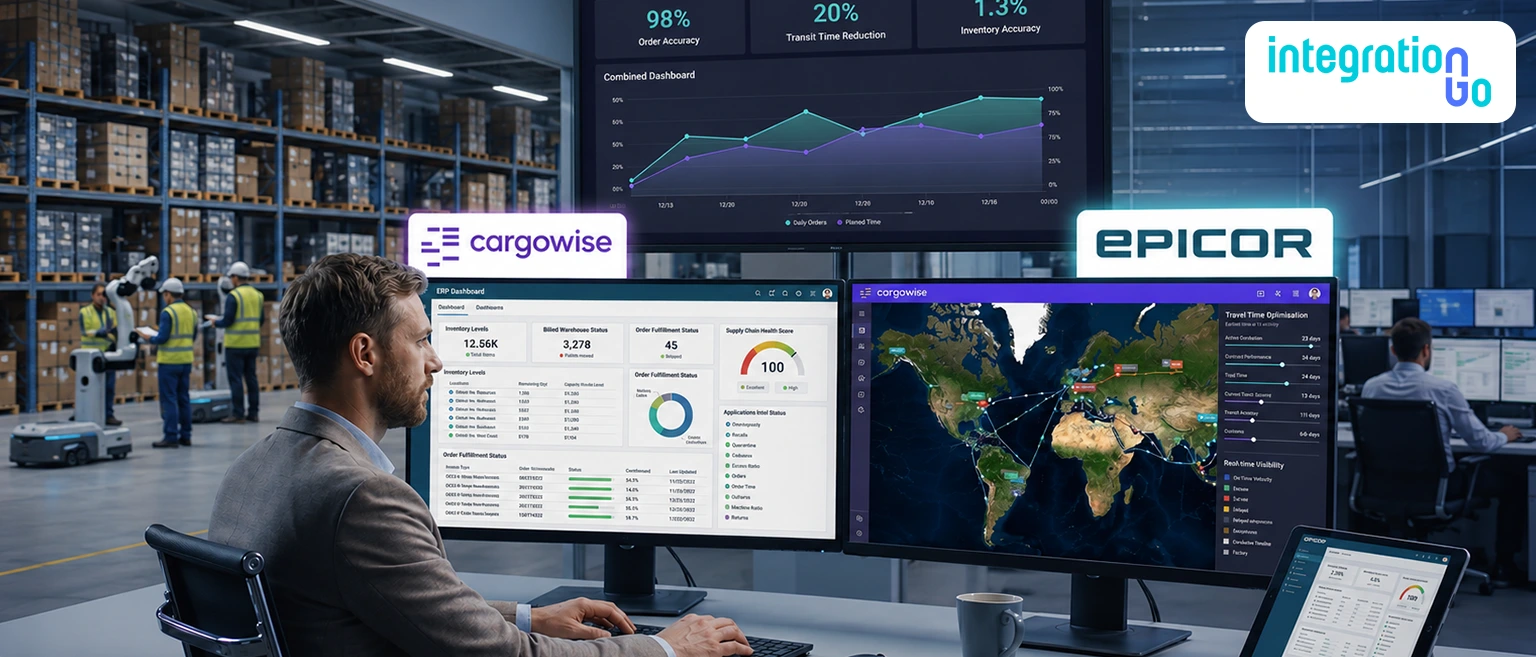
That’s why integrating CargoWise with Epicor ERP has become essential for logistics businesses looking to improve supply chain visibility, financial accuracy, and operational efficiency in real time.
What is CargoWise and its Growing Role in Modern Freight Operations?
CargoWise has become one of the most widely used cloud-based logistics ERP platforms because it integrates multiple freight workflows into one operational environment.
Instead of managing transportation, customs, warehousing, and accounting separately, CargoWise allows freight forwarders to manage the complete shipment lifecycle in one system.
The platform supports:
- Freight forwarding across air, ocean, and road
- Customs and compliance workflows
- Warehouse and inventory operations
- Shipment tracking and milestone visibility
- Financial workflows and invoicing
For freight forwarders handling international operations, this creates a centralized operational structure where shipment updates, customs activities, and financial records remain synchronized in real time.
One of CargoWise’s biggest strengths is its ability to support complex multi-country operations while maintaining operational visibility across transportation, customs, warehouse, and accounting workflows.
Because CargoWise functions as both a logistics ERP and transportation platform, it becomes the operational backbone of many freight forwarding businesses.
Epicor ERP and its Role in Supply Chain and Financial Visibility
While CargoWise focuses on logistics execution, Epicor ERP manages the broader business infrastructure behind supply chain operations.
Epicor is widely used for:
- Financial reporting and accounting
- Procurement and inventory planning
- Accounts payable and receivable
- Operational reporting and analytics
- Enterprise resource planning workflows
For logistics organizations, Epicor provides the financial visibility needed to monitor profitability, inventory costs, procurement activity, and operational performance at scale.
But while Epicor handles enterprise planning extremely well, it does not directly manage transportation execution, customs workflows, or shipment operations. That’s why CargoWise End-to-End Integration. When these systems operate separately, businesses lose visibility between operational execution and financial performance.
Operational Gaps Created by Disconnected Logistics and ERP Systems
Many logistics businesses experience the same operational issue: operations and finance teams work from different systems that don’t fully communicate.
A shipment may be completed in CargoWise, but finance may not see the updated operational costs in Epicor immediately. Inventory movement may happen in the warehouse, while procurement and accounting records remain delayed.
Over time, these gaps create operational inefficiencies such as:
- Delayed invoice generation and slower revenue recognition
- Manual reconciliation between operations and finance
- Inconsistent shipment costing and profitability tracking
- Reduced visibility into inventory and shipment-level performance
- Increased administrative workload across departments
As logistics operations scale, these inefficiencies become harder to manage and begin affecting overall supply chain performance.
Real-Time Visibility Across Logistics, Inventory, and Financial Workflows
When CargoWise and Epicor ERP are integrated, logistics execution and enterprise financial management begin operating together in real time.
Instead of manually transferring information between systems, shipment updates, inventory movement, customs activity, and financial records move automatically across both environments.
This creates a connected operational structure where:
- Shipment execution updates financial workflows instantly
- Inventory activity remains aligned with operational movement
- Financial reporting reflects real-time logistics performance
- Procurement and warehouse workflows stay synchronized
- Customs and transportation processes remain connected
The result is stronger visibility across the entire supply chain. Operations teams gain faster access to financial insights, while finance teams gain better visibility into transportation and warehouse performance.
Instead of reacting to disconnected information, businesses gain the ability to make faster and more accurate operational decisions.
Faster Financial Workflows and Better Shipment-Level Cost Visibility
One of the biggest operational improvements achieved by the integration of CargoWise and Epicor ERP is financial synchronization.
Without integration, finance teams often rely on spreadsheets, delayed uploads, or manual reporting to coordinate shipment costs with accounting systems.
Integration removes these obstacles by ensuring operational data flows directly into Epicor in real time.
This improves:
- Shipment-level profitability visibility
- Invoice creation and financial posting accuracy
- Revenue recognition timing
- Inventory and warehouse cost tracking
- Financial forecasting and reporting
As a result, finance teams spend less time reconciling operational data and more time focusing on strategic analysis and planning.
This creates stronger confidence in operational reporting and improves overall supply chain efficiency.
Stronger Coordination Between Operations, Finance, and Warehouse Teams
Disconnected systems often force teams to operate independently. Operations may focus on shipment execution while finance manages accounting separately, creating delays and communication gaps between departments.
Integration changes this dynamic entirely. When CargoWise and Epicor ERP operate together, every department works from the same operational data.
This improves:
- Coordination between warehouse and transportation teams
- Visibility into inventory and shipment status
- Financial awareness across operational workflows
- Communication between finance and logistics departments
The result is a much more connected operational environment where teams spend less time verifying information and more time managing supply chain performance.
How IntegrationGo Integrate CargoWise and Epicor ERP Across Supply Chain Workflows?
Integrating CargoWise with Epicor requires more than a simple data exchange. Supply chain operations involve transportation workflows, inventory movement, customs processes, and financial transactions that all need to remain synchronized in real time.
IntegrationGo acts as the intermediary layer that connects these systems through a structured integration process designed around operational accuracy, scalability, and long-term stability.
The integration workflow begins with Project Management, where the complete integration scope, timelines, operational workflows, and system dependencies are planned and aligned. This ensures that both operational and technical teams work from a clear implementation structure before development begins.
The next phase focuses on Requirements Analysis. During this stage, business and technical requirements are gathered and analyzed to understand how shipment data, inventory workflows, customs activity, and financial records should move between CargoWise and Epicor ERP. This step is critical because every logistics organization operates differently, and the integration must reflect real operational workflows rather than generic system connections.
Once workflows are defined, the process moves into Environment Setup. Here, the web server, AS2 server, CargoWise environment, and surrounding integration infrastructure are configured to support secure communication and scalable data exchange across systems.
After the environment is prepared, Development begins. This stage includes implementing specific EDI connections, configuring system mappings, and setting up integration with eAdaptor to ensure that shipment updates, financial transactions, customs workflows, and inventory movements synchronize correctly between CargoWise and Epicor ERP.
Before going live, the integration enters Integration Testing. During this phase, the entire workflow is tested to validate data flow, synchronization accuracy, operational functionality, and workflow reliability. Shipment visibility, inventory updates, invoice creation, and financial posting are all verified to ensure operational consistency across systems.
Once testing is completed successfully, the process moves into Deployment. The integration solution is deployed into both testing and production environments, ensuring that businesses can transition into live operational workflows without disrupting ongoing supply chain activities.
Finally, IntegrationGo provides complete Documentation, including architecture diagrams, EDI-to-CargoWise mapping documentation, CargoWise setup guides, and EDI configuration references. This ensures that businesses maintain visibility into how the integration environment operates while supporting future scalability and ongoing operational support.
This structured integration approach allows CargoWise and Epicor ERP to function as one connected operational ecosystem instead of two disconnected systems.
Building a More Scalable and Connected Supply Chain Environment
As logistics operations grow, disconnected workflows become increasingly difficult to manage. More shipments, more inventory movement, and more financial transactions create operational complexity that manual processes cannot support efficiently.
Integrated systems create a much stronger operational foundation for scalability.
Businesses gain:
- Better operational visibility across departments
- Faster coordination between logistics and finance
- Improved inventory synchronization
- Reduced manual workload and reconciliation
- Stronger decision-making through real-time insights
This allows logistics organizations to scale while maintaining operational control and supply chain visibility.
Conclusion
Modern supply chains depend on integrated systems that allow logistics, inventory, customs, and financial workflows to move together in real time.
CargoWise and Epicor ERP integration helps businesses eliminate operational silos, improve visibility, and create a more efficient supply chain environment. Schedule a demo today to explore how connected CargoWise and Epicor ERP workflows can simplify operations and create true end-to-end supply chain visibility