
What happens when every freight invoice must be generated in a government-approved digital format directly from your operational system, without manual adjustments?
The UAE will begin transitioning to its Electronic Invoicing System (EIS) in July 2026, with full compliance becoming mandatory by 2027.
For freight forwarders operating in CargoWise, this is not just about reporting. It reshapes how invoice data is structured at the shipment level, from charge codes and tax calculations to validation and real-time submission to the Federal Tax Authority (FTA).
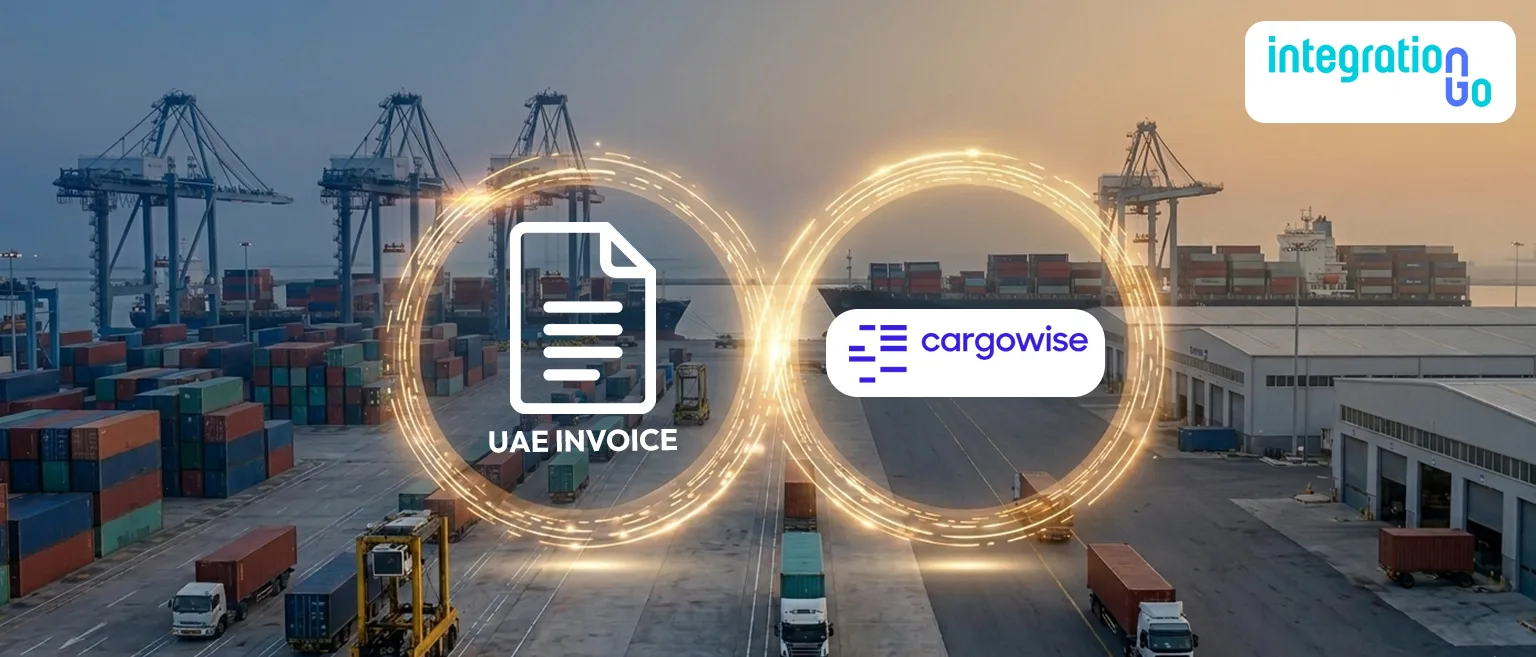
That’s why e-Invoicing integration within CargoWise becomes critical. Compliance now starts inside your operational workflow, not after the invoice is issued.
So what does this mandate really mean for your freight business?
What is E-Invoicing in the UAE?
E-invoicing in the UAE refers to the structured digital creation, exchange, and reporting of invoices through the government’s Electronic Invoicing System.
Unlike traditional PDFs or paper invoices, a valid UAE e-invoice must:
- Be generated in structured XML format (Peppol PINT-AE standard)
- Be transmitted through the middleware (IntegrationGo)
- Be reported in near real-time to the FTA
- Receive electronic confirmations through the Peppol 5-corner model
- Exclude PDFs, scanned copies, or manually emailed invoices
To put it simply, a PDF attachment is no longer considered a compliant invoice.
The 2026–2027 Rollout Timeline (Know Your Deadline)
The UAE Ministry of Finance has outlined a phased rollout under the Electronic Invoicing System (EIS):
Pilot Program
• Starts: 1 July 2026
Voluntary Adoption
• Available from: 1 July 2026
Phase 1 – Revenue ≥ AED 50M
• Appoint ASP by 31 July 2026
• Mandatory go-live: 1 January 2027
Phase 2 – Revenue < AED 50M
• Appoint ASP by 31 March 2027
• Mandatory go-live: 1 July 2027
Government Entities
• Mandatory by: 1 October 2027
Most mid-sized freight forwarders will fall into Phase 2, but waiting until 2027 to prepare would be a strategic mistake.
Why should Freight Forwarders Pay Attention Now?
Freight invoicing is a high-volume, operationally driven process in which each cargo generates many charges, tax treatments, and financial validations. That complication is precisely what makes structured e-invoicing integration necessary.
You manage:
- Multi-currency billing
- Shipment-level cost allocations
- VAT and zero-rated exports
- Reverse charge commodities
- Credit notes and adjustments
- Incoterms and customs references
- Self-billing scenarios
- High invoice volumes
Under the new system, every invoice must be structured in XML, validated through an IntegrationGo, and digitally reported to the FTA.
Manual AR processes will not scale.
Freight invoicing is a high-volume, operationally driven process in which each cargo generates many charges, tax treatments, and financial validations. That complication is precisely what makes structured e-invoicing integration necessary.
E-Invoicing Requirements Freight Forwarders Must Meet
To comply, your business must:
- Generate invoices only in XML format
- Use PEPPOL PINT-AE structured standards
- Appoint and onboard with one IntegrationGo
- Transmit invoices and credit notes via ASP
- Include mandatory VAT fields and tax categories
- Store invoice data securely and retrievably
- Maintain data for 5+ years
- Handle confirmation messages and validation responses
This isn’t just accounting compliance; it’s operational integration.
E-invoicing integration in CargoWise: What it Really Means?
This is the important part. CargoWise is your operational backbone, but it doesn’t automatically become compliant just because you generate invoices inside it.
To comply, CargoWise must:
- Extract invoice data in structured XML format
- Map charge codes to UAE tax categories
- Handle VAT, zero-rated, reverse charge classifications
- Integrate directly with Cargowise
- Transmit invoices in real-time
- Receive electronic validation confirmations
- Track UUIDs generated for each invoice
- Store confirmation logs for audit trail
Without integration, teams will end up manually uploading XML files into ASP portals, which defeats the purpose and increases compliance risk.
Integration ensures:
- Automated invoice transmission
- Reduced manual data entry
- Faster invoice validation
- Fewer tax mapping errors
- Stronger audit trail
- Scalable compliance
What Happens if You Don’t Integrate Properly?
Let’s be honest.
Without proper integration:
- Invoices may fail validation
- Reverse charge logic may be incorrect
- VAT reports may mismatch
- Audit trails may be incomplete
- Duplicate invoices may occur
- Penalties may apply after your mandatory go-live date
Compliance gaps grow fast when transaction volume increases.
How IntegrationGo Supports CargoWise E-Invoicing Integration?
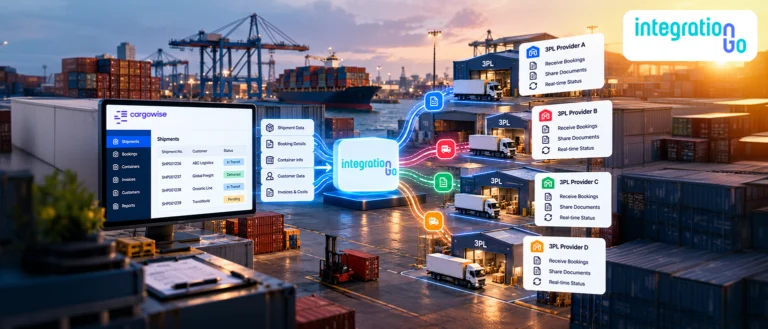
IntegrationGo operates as middleware designed specifically for ERP and logistics system integrations. In the context of the UAE e-invoicing mandate, it acts as the structured bridge between CargoWise and your middleware, which is integrationGo
CargoWise manages your shipment execution, charge codes, cost allocations, and invoicing data. The ASP manages validation and reporting to the Federal Tax Authority. But these two environments do not automatically communicate in a compliant, structured format.
That’s where IntegrationGo becomes critical.
- Extracts invoice data directly from CargoWise
- Transforms it into structured XML aligned with UAE standards
- Maps freight charge codes to the correct VAT classifications
- Connects securely with your chosen ASP
- Automates invoice and credit note transmission
- Captures validation responses and UUID confirmations
- Maintains audit logs for compliance visibility
Instead of relying on manual XML uploads or disconnected processes, IntegrationGo ensures your operational ERP integrates cleanly with the UAE’s e-invoicing framework.
This reduces compliance risk, eliminates repetitive manual handling, and allows freight businesses to scale invoice volumes without increasing reporting complexity.
Conclusion
The UAE e-invoicing mandate signals a clear shift toward structured, real-time digital compliance.
For freight forwarders using CargoWise, readiness depends on end-to-end integration connecting operational data, charge codes, tax mapping, XML generation, and ASP transmission into one seamless flow.
When systems are fully connected, compliance becomes accurate, automated, and scalable.
Preparing for 2027 starts now. Contact us to assess your CargoWise and E-Invoicing integration readiness.