
Shipments are moving, orders are processed, invoices are generated, and customs declarations are filed. On the surface, everything looks connected.
But behind the scenes, many businesses still operate with systems that don’t fully align.
Shipment updates don’t reflect immediately in financial systems. Customs declarations often contain data that differs slightly from invoices. As a result, accounting relies on delayed inputs, forcing teams to chase and reconcile data instead of using it effectively.
That’s the gap where efficiency is lost.
End-to-end logistics integration is about more than moving cargo, it’s about making sure every system involved in the process moves data together in real time.
This is where SAP integration transforms how logistics, finance, and customs operations work together, bringing structure, consistency, and real-time visibility across systems.
What is SAP and Why is it the Core System for Business Operations?
SAP is a cloud-based enterprise resource planning (ERP) system designed to centralize business processes such as finance, procurement, inventory, and operational management. It acts as the system of record where critical business data is stored, processed, and analyzed.
SAP is an important part of logistics-driven businesses because it helps them keep track of their financial performance, manage their operational costs, and make sure that all transactions are the same. SAP is the last place that every shipment, invoice, and cost allocation ends up.
However, modern supply chains rely on specialized systems beyond SAP. Logistics execution often happens in platforms like CargoWise, customs compliance is handled through dedicated systems, and accounting processes may run through software such as Sage 50, NetSuite, Xero, or QuickBooks. Each requires smooth integration with CargoWise or your ERP to ensure financial accuracy and real-time visibility.
Without proper integration, such as connecting SAP with CargoWise, data remains fragmented across systems, leading to delays, inconsistencies, and manual intervention
While SAP holds the core data, these systems handle execution across different stages of the workflow. Without integration, they operate independently, creating gaps that affect visibility and efficiency.
What is SAP Integration and How does it Connect Logistics, Finance, and Customs?
SAP integration connects SAP with external systems so that data flows automatically across logistics, finance, customs, and accounting platforms. Instead of relying on manual updates or delayed synchronization, SAP system integration ensures that every system operates on the same real-time data.
An SAP integration suite provides the technical framework for this connectivity. It enables SAP to exchange data with both SAP and non-SAP systems, ensuring consistent communication across the business ecosystem.
When SAP integration is implemented effectively, operational events trigger financial updates instantly, and compliance processes receive accurate information without manual intervention.
This means that:
- Shipment execution automatically reflects in financial records
- Invoice creation aligns with operational milestones
- Customs declarations are prepared using validated and consistent data
- Accounting systems receive real-time updates from both operations and finance
Instead of working in disconnected stages, these processes become part of a continuous, synchronized workflow.
What Happens When SAP System Integration is Missing in Logistics Workflows?
When SAP is not integrated with logistics, customs, and accounting systems, the impact becomes visible in everyday operations.
Data does not move in real time, and teams rely on manual processes to bridge the gap. A shipment may be completed, but financial updates lag behind. Customs declarations may require re-validation, and accounting systems may reflect outdated data.
Over time, this leads to inefficiencies such as:
- Delays in invoice generation and revenue recognition
- Increased manual effort in reconciling data across systems
- Inconsistent information between logistics, customs, and finance
- Slower customs clearance due to mismatched data
- Reduced visibility into operational and financial performance
These challenges create friction across workflows and affect the overall speed and accuracy of business operations.
What Role does SAP Integration Play in End-to-End Logistics Visibility?
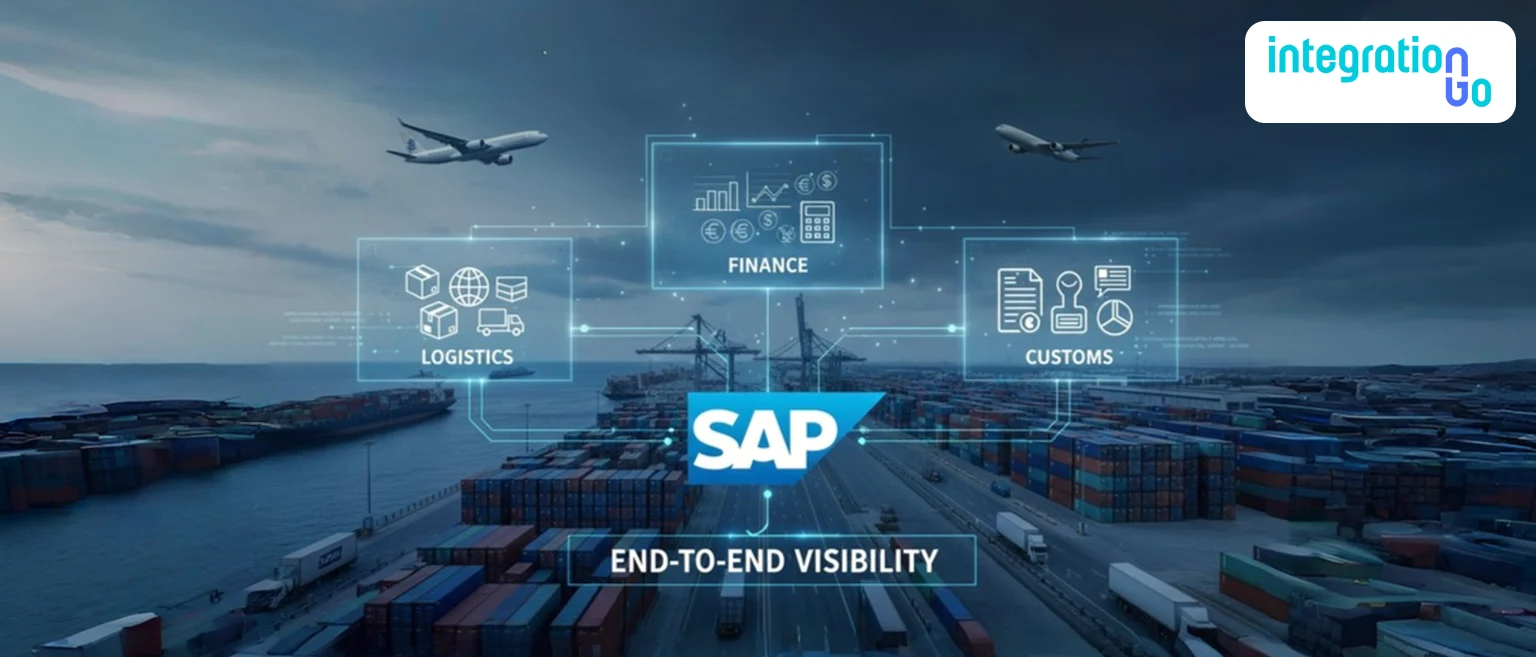
SAP integration enables true end-to-end visibility by connecting logistics execution, financial processing, customs compliance, and accounting workflows into a single data flow.
When systems are connected, every event in the supply chain is reflected across the organization in real time. A shipment update in the logistics system automatically updates SAP. Financial systems reflect the cost impact immediately. Customs systems receive accurate data for declaration processing.
This allows businesses to:
- Track shipments along with their financial impact
- Monitor customs status without switching systems
- Access real-time cost and revenue insights
- Make faster decisions based on accurate data
End-to-end visibility is not just about seeing data, it’s about trusting that data across every system.
What Role does IntegrationGo Play as the Intermediary Between Systems?
While an SAP integration suite provides the capability to connect systems, businesses need a structured intermediary to manage how data flows between them. IntegrationGo fulfills this role by acting as the bridge between SAP, logistics platforms, customs systems, and accounting software.
Instead of systems connecting directly, which can create complexity, IntegrationGo manages data flow in a controlled and consistent way. It ensures that data is mapped, transformed, and delivered accurately across systems.
Through this intermediary layer:
- SAP data is synchronized with logistics platforms in real time
- Customs systems receive accurate and validated shipment information
- Accounting software reflects financial updates instantly
- Updates from external systems flow back into SAP seamlessly
IntegrationGo ensures that every system operates with consistent and reliable data, enabling a fully connected workflow.
What Benefits do Businesses Experience with SAP Integration?
When SAP integration is implemented with a strong intermediary like IntegrationGo, businesses begin to experience improvements across operations, finance, and compliance.
Key benefits include:
- Faster invoicing cycles with reduced delays
- Improved data accuracy across all systems
- Real-time visibility into logistics and financial performance
- Reduced manual effort in reconciliation and data entry
- Stronger customs compliance through consistent data validation
In addition to these improvements, teams gain better coordination across departments, allowing operations, finance, and compliance teams to work with the same information at the same time.
What Makes SAP Integration Essential for Scaling Logistics Operations?
As logistics operations grow, the complexity of managing multiple systems increases. More shipments, more transactions, and more regulatory requirements create a higher demand for accurate and timely data.
Without integration, this growth leads to increased manual effort and a higher risk of errors. Processes become slower, and teams struggle to keep up with operational demands.
With SAP system integration supported by an SAP integration suite and an intermediary like IntegrationGo, businesses can scale efficiently. Data flows automatically, processes remain consistent, and teams can handle higher volumes without additional pressure.
This allows organizations to grow while maintaining operational control and efficiency.
Conclusion
SAP integration brings logistics, finance, customs, and accounting systems into one connected flow, turning fragmented processes into a simple and reliable operation. When data moves consistently across systems, teams gain real-time visibility, reduce delays, and operate with greater confidence across every stage of the supply chain.
With IntegrationGo acting as the intermediary layer, this connection becomes structured, scalable, and aligned with real business workflows, ensuring your systems don’t just connect but truly work together. Contact us today to explore how SAP integration can simplify your operations, improve data accuracy, and deliver real-time visibility across your logistics ecosystem.